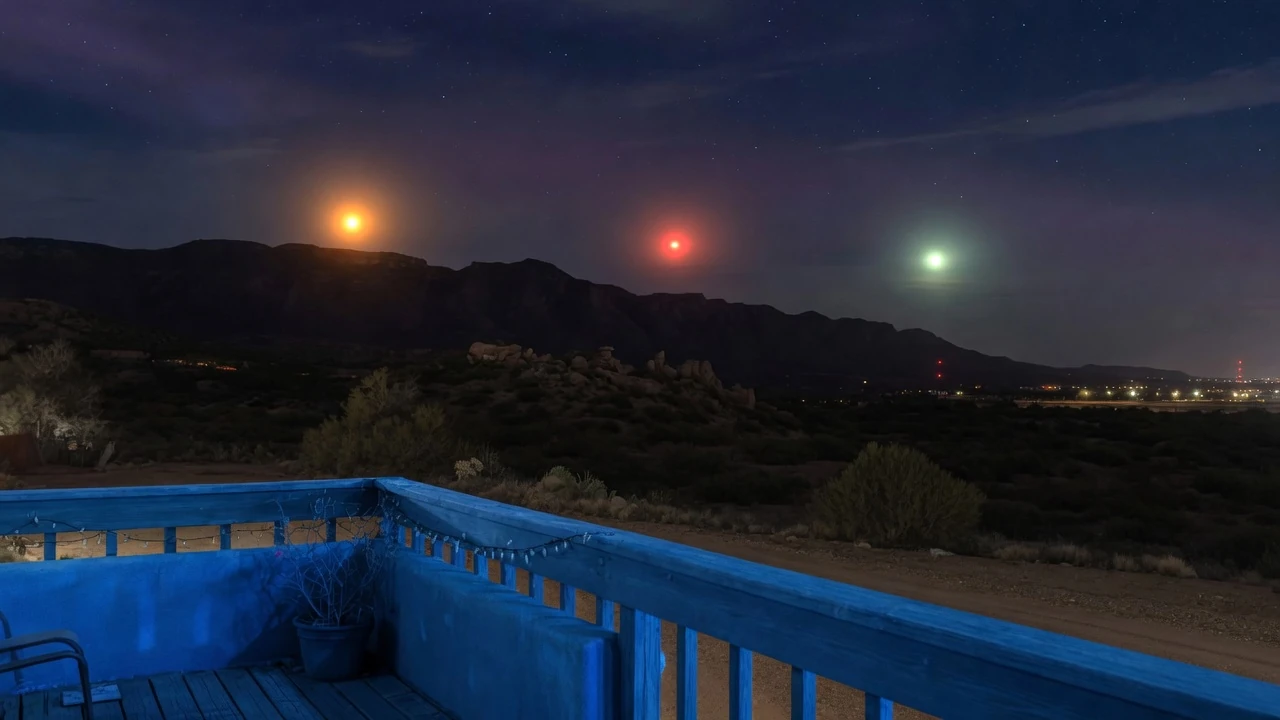
On a cold night in the winter of 1979, Paul Frederic Bennewitz Jr. walked out onto the second-story deck of his house in Albuquerque's Four Hills neighborhood and looked south toward a dark little mountain range inside Kirtland Air Force Base.
He had been doing this since September. Colored lights drifted, then shot away. His wife Cindy saw them too. The ridge wasn't an ordinary hill. It was the Manzano Weapons Storage Complex, then one of the largest underground stores of nuclear weapons components in the Western world, about a mile from his backyard.[1]
Bennewitz wasn't a hobbyist with a Polaroid. He ran Thunder Scientific, a family company that built temperature and humidity instruments for NASA and the Air Force. The shop sat on the edge of the same base. He was also an aerobatics pilot. In the years that followed he would take a plane up and look down on objects he believed were crashed craft and the surface works of an underground alien base. Later accounts of the Air Force operation against him say some of those objects were put there for him to find.[15]
He filmed the lights: hundreds of stills, thousands of feet of 8-millimeter film. He pointed antennas at the ridge and recorded radio that didn't sound like anything he recognized. By July 1979 he was calling the work a personally funded study. By August 1988 his family would have him committed. In between, the Air Force Office of Special Investigations (AFOSI) - the Air Force's own investigative service, closer to a military FBI than to a public-affairs office - decided the safest thing to do with a contractor who would not look away was to convince him he had found a war with aliens.
The neighbor with the lab
Bennewitz was born September 29, 1927, in Kansas. He joined the Coast Guard at seventeen, late in World War II, as a radio electronics engineer. After the war he worked broadcast engineering at KPIX in San Francisco and KPHO in Tucson. In 1949 he married Cindy Bunch in Phoenix. They moved to New Mexico around 1953. He sold for Gulton Industries, then started his own industrial sales company. In 1966 he acquired the rights to a humidity sensor from Sandia National Laboratories, the nuclear-weapons engineering lab that shares land with Kirtland, and built Thunder Scientific around it, with Cindy as bookkeeper.[2]
Greg Bishop, the journalist who later wrote the standard book on this case, Project Beta: The Story of Paul Bennewitz, National Security, and the Creation of a Modern UFO Myth (2005), describes a man with a master's-level physics background who meant to finish a doctorate and never did. There was no serious dispute that he could build gear and read signals. By April 1981 the Albuquerque Tribune was profiling Thunder as a million-dollar shop that had slimmed from thirty employees to eighteen. Bishop's opening chapter puts the lab on the base line: if there had been a hole in the fence, Bennewitz could have shaken hands with a guard from the backyard or from work.[1]
In the 1970s he joined the Aerial Phenomena Research Organization (APRO), a civilian UFO investigation group then based in Arizona. Think of it as a predecessor and rival to MUFON, the Mutual UFO Network, which still exists. Around the same years, ranchers and police in northern New Mexico were logging cattle found dead with clean cuts, missing organs, and little blood - cases the press bundled as "cattle mutilations." Some people blamed predators and scavengers. Some blamed cults. Some blamed aircraft. A growing group blamed visitors.
On April 20, 1979, U.S. Attorney R. E. Thompson and Senator Harrison Schmitt - New Mexico's senator, and before that the Apollo 17 astronaut who walked on the Moon - held a public meeting on the mutilations at the Albuquerque Public Library. About eighty people came. Bennewitz was one of them. So was New Mexico State Police officer Gabe Valdez, who had been working the cases around Dulce, a small town on the Jicarilla Apache Nation near the Colorado line. The 2013 documentary Mirage Men later suggests this may be the night government employees first marked Bennewitz, or at least first put a name to a man who was already watching the base.[2]
Video: news package on the FBI cattle-mutilation file and Senator Harrison Schmitt's push for a New Mexico investigation in 1979. A full recording of the April 20 Albuquerque Public Library meeting itself does not appear to be online.[13]
Bennewitz listed July 1979 as the start of the study. The lights over Manzano were routine by then. What he did next was what a man of his background would do. He started measuring.
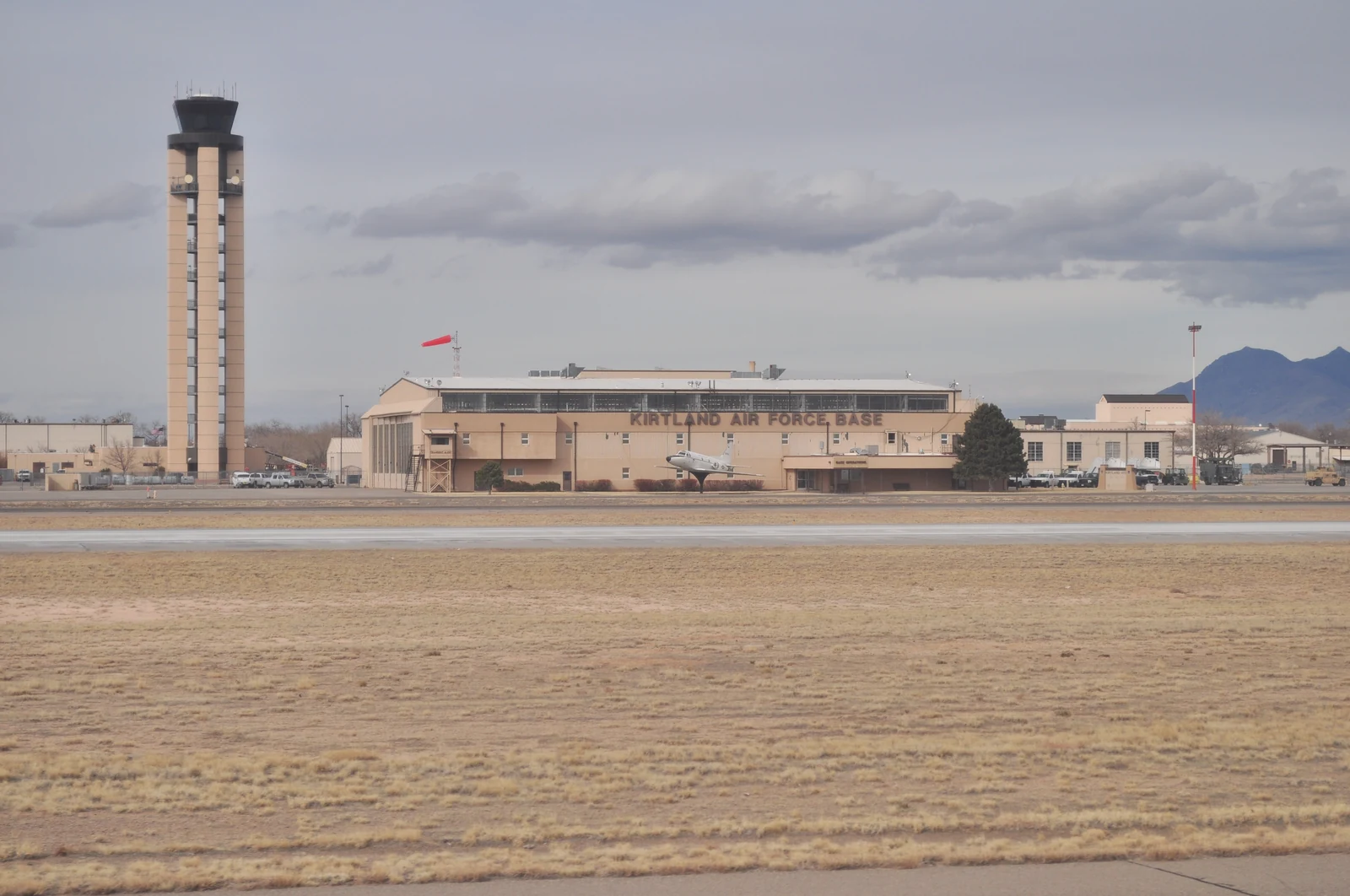
Kirtland Air Force Base, Albuquerque. Photo by Joe Mabel, 26 Feb. 2015. CC BY 3.0.
Who's who
A lot of names show up in this story. Here are the main ones, so it's easier to keep them straight.
- Paul Bennewitz - Albuquerque instrument maker. Lived and worked on the edge of Kirtland. Filmed the lights.
- Cindy Bennewitz - his wife. Saw the lights too. Later had him hospitalized.
- Gabe Valdez - New Mexico State Police officer who worked cattle-mutilation cases around Dulce.
- Myrna Hansen - woman whose 1980 story, under hypnosis, is where the Dulce underground-base legend starts.
- Leo Sprinkle and James Harder - the two hypnotists Bennewitz brought in for Hansen.
- Richard Doty - AFOSI special agent at Kirtland. Later said his job was to mislead Bennewitz.
- Bill Moore - UFO author sent to look at Bennewitz. Later admitted he passed him fake documents.
- Greg Bishop - journalist who wrote Project Beta, the standard book on the case.
A woman named Myrna Hansen
On May 6, 1980, state police in Cimarron, New Mexico, took a call from a woman using the name Myrna Hansen - not the 1950s film actress - who described bright lights, cattle, and visitors who were not from here. Cimarron forwarded it to Valdez in Dulce, already known as "the cattle mutilation guy." Valdez called Bennewitz.
The next day Hansen and her son drove to Albuquerque and stayed in the Bennewitz house. She told him that on May 5, while driving near Eagle Nest with her son, she had seen two silent objects the size of Goodyear blimps hanging over a meadow.
James Lorenzen of APRO suggested bringing in Leo Sprinkle, a University of Wyoming psychologist who already took UFO-contact reports seriously enough to hypnotize the people who made them. Sprinkle flew in. Hansen and Bennewitz insisted the first session happen in Bennewitz's Lincoln Town Car, parked in the garage with the windows wrapped in thick aluminum foil. In that first session she described a cow being pulled into a hovering ship. On May 11 and 12, still under hypnosis, she described an underground facility, body parts in vats, and an implant. She asked, out loud, "Where's Roswell, New Mexico?" years before most of the public had attached that town to flying saucers. Those sessions are where the Dulce Base story starts: the claim that a joint human-alien laboratory sits under Archuleta Mesa, northwest of Dulce, and that cattle and people are used there.[2]
Sprinkle was based at the University of Wyoming. After the mid-May sessions he went home, then flew back to Albuquerque on June 3 for more work on Hansen's case. At the Four Hills house he found Bennewitz carrying a pistol and a rifle, talking about protecting his family and Hansen from an attack. The public record of that visit does not say the arrival was a surprise. It was a return trip to the same house, about three weeks later, and the change Sprinkle noticed was the guns.
Bennewitz then brought in another hypnotist, James Harder, a University of California engineer who in 1975 had hypnotized Travis Walton, the Arizona logger who said a craft had taken him from a work crew in the Apache-Sitgreaves forest. Harder and Bennewitz believed Hansen was still under the influence of alien "beams" - electromagnetic signals they thought could reach an implant and steer her memory, or break a session.
Both men were engineers. The fix they wrote out was simple radio physics they could do at home: wrap a room in aluminum foil so it worked like a Faraday cage, a metal enclosure that blocks radio-frequency energy. The earlier Lincoln sessions had used the same idea on a smaller scale, with thick foil over the car windows. For Harder they scaled it up - detailed foil instructions for a room, makeshift cages, and, in Bishop's reconstruction, umbrellas lined on the underside with foil and held over Hansen while she was under. Then they started the regression.
Years later, Gabe Valdez's son Greg Valdez went further. In Dulce Base: The Truth and Evidence from the Case Files of Gabe Valdez and in interviews for Adam Gorightly's Saucers, Spooks and Kooks, he said the Hansen story itself may have been part of the same disinformation campaign. He would "go out on a limb" and call it a well-orchestrated hoax. He didn't name Hansen as a CIA officer. What he said was that once the phones were open, any agency that wanted a witness on the line could have built one.
The reason he thought that was possible is the bugs. Greg Valdez has said listening devices turned up in his father's house, in the home of Dulce rancher Manuel Gomez - the man whose cattle cases Gabe had been working - and at the Jicarilla tribal police department. He writes that the NSA or the CIA were the likely hands, and that nobody produced a search warrant. The public record is thinner on the moment of discovery: this is the family's later account, not a published inventory or a courtroom exhibit. If the devices were real, anyone on those lines would have heard every call between Valdez and Bennewitz, including the May 6 referral that put Hansen in the Four Hills house the next day.
Hansen arrived in May. AFOSI's official paper trail with Bennewitz does not start until October and November. That gap isn't a confession. Official contact isn't the same as unofficial contact, and the Air Force isn't the whole government. AFOSI could have been watching him before it wrote him down. The CIA, the NSA, and other shops could have been on the same phones without ever appearing in a Kirtland memo. Greg Valdez himself called the Hansen-as-plant reading barely circumstantial.
If someone did send her, the timing is why people still talk about it. By the time Kirtland logged a briefing, Bennewitz already had an abductee in his house, a foil-wrapped car, an underground-base story, and a reason to look north at Dulce instead of only at the mountain next door. A planted witness would explain how that whole underground-base story showed up months before the Air Force admitted it was talking to him, and how it showed up along a phone line that - if Greg Valdez is right about the bugs - was already being listened to. None of that is the same as proving Hansen was an asset. She could've been a genuine frightened driver, a hoaxer working on her own, or a person whose story was later useful to people who had not created it. The file does not close those three. It only shows that if someone wanted to send a fake witness, the phones and the timing would have made it easy.
He called the base
On October 24, 1980, Bennewitz called Kirtland Air Force Base - the huge Albuquerque base that held the Manzano weapons mountain he had been filming from his backyard - and reported the lights, the film, and the radio. On November 10, 1980 he went on base and briefed officers in person. Greg Bishop, the journalist who later wrote the standard book on this case, reconstructs a room that included senior people from Kirtland and from Sandia, the nuclear-weapons lab that shares the same ground. Bennewitz put his film, his tapes, and his reading of them on a table inside the base perimeter he had been watching from Four Hills, his neighborhood on the fence line, for more than a year.
An AFOSI Form 96 dated November 26, 1980 names the room. Brig. Gen. William Brooksher was there, along with several colonels from the 1606th Air Base Wing, Col. Frank Huey of AFOSI District 17, Maj. Thomas Cseh, a Dr. Lehman from the Air Force weapons lab, and an instrumentation specialist named Ed Breen. The form says Bennewitz showed film and stills of objects over Kirtland from the last fifteen months, and that he also claimed "documented proof that he was in contact with the aliens flying the objects." He asked the Air Force for money to keep going. Lehman told him to apply for a research grant. A week later, on November 17, Special Agent Richard C. Doty told him AFOSI would not get involved. On November 26 someone calling himself Senator Harrison Schmitt - New Mexico's senator, the Apollo 17 astronaut from the 1979 cattle-mutilation meeting - phoned Doty to ask what AFOSI was doing about the lights. The form says Bennewitz had already been talking to Schmitt for months, and that Schmitt had called Brooksher about security at the Manzano storage area.[22]
What happened after that meeting is the part of the story that is no longer only folklore. On paper, Doty had just told Bennewitz that AFOSI would stay out. The problem wasn't "is there an alien base." The problem was a civilian with cameras, antennas, a company on the perimeter, and a habit of talking. Doty became the person who dealt with him.
Years later, on camera, Doty said he didn't freelance. Supervisors, he said, didn't want Bennewitz going public claiming he had tapped a secret system at Kirtland. In the Showtime series UFO he puts it as a job: keep Bennewitz from talking about whatever classified work he might have filmed, by giving him a crazier story instead - aliens, an underground base, an invasion. A claim that wild is easy to laugh off. A contractor with film of a real test over a nuclear storage mountain is not.[3]
Video: Greg Bishop, author of Project Beta, on UFOs and the U.S. government, including the Bennewitz case.[12]
The method, as later described by Doty, by ufologist William L. "Bill" Moore, and by writers who reconstructed the paper trail, was simple and ugly. Befriend the man. Confirm the lights. Hand him documents that looked official and were not. Give his computer something to "decode." Point him north toward Dulce. The more spectacular the story got, the less anyone serious would believe the original, smaller claim: that something unusual was flying around a nuclear storage mountain, and a contractor next door had film of it.
The middleman from APRO
APRO sent Moore to look at Bennewitz. Moore was already a name in the field. With Charles Berlitz he had co-authored The Roswell Incident (1980), the book that took a 1947 New Mexico crash story out of local memory and made it national folklore. He later said AFOSI recruited him in 1980 to report on Bennewitz "and to a lesser extent several other individuals." In exchange he got access, documents, and the sense that he was being let in on something.
One of the first things he was asked to do was pass Bennewitz a "sanitized" paper riddled with alterations. When Moore asked why, he was told it had to be cleaned to protect projects. He understood he was lying to another researcher. The plan, as he later told it, was that Bennewitz would wave the paper at the press, the paper would be denounced as fake, and Bennewitz would look like a crank.[4]
That is also how the Aquarius document got around: a memo that purported to describe a classified UFO program, complete with official-looking stamps and redactions. Later, the MJ-12 papers - a set of documents that claimed President Truman had created a secret committee to manage recovered craft and bodies - traveled through some of the same hands. How much of that pile was Doty, how much was Moore, how much was someone further up, and how much was ufologists passing each other's forgeries along as if they were new is still argued. What is not seriously argued anymore is that Bennewitz was being given fake material on purpose.
The computer that talked back
Bennewitz didn't only watch. He built. He put up directional antennas, ran receivers toward the ridge and later toward Archuleta Mesa, and treated the pulses as data. He believed he could turn the noise into language.
Later reconstructions say AFOSI made that easier. In Mark Pilkington's reporting for Mirage Men - the 2010 book behind the 2013 film - investigators gave Bennewitz computer software that "interpreted" the signals. Other summaries of the same campaign say they supplied a machine for the job. Either way, by the early 1980s Bennewitz believed he was in a two-way conversation with the visitors: warnings, base gossip, abduction logistics. On April 8, 1983, UPI moved a story about his 1980 filming over Manzano and about those computer conversations. A news service had picked it up. His private study was in the papers.[15]
Bishop, via later academic writeups of his book, also describes a long fabricated history handed to Bennewitz: a race called the "Ebans" from a green planet, another called the "Sweads," a limited war between creator and created. The made-up names were useful. If they showed up in an intercept, someone downstream would know which conversation they were listening to. "Sweads" looks like a twist on the 1950s "space brother" stories about tall blond "Swedes." "Ebans" looks like a twist on EBE, "extraterrestrial biological entity," a phrase that later showed up all over the MJ-12 rumor.[4]
What he saw from the air
Bennewitz didn't stay on the deck. He was a pilot. He paid for flying time and used the plane to look over northern New Mexico - over the mesa country around Dulce, and over the hills he had already decided were hiding wreckage.
From the air he reported seeing what looked like crashed craft and the surface signs of an underground facility. This is one of the craziest parts of the whole story, because it's not just a fake memo on a desk. If the later accounts are right, people in government were willing to dress the land itself so Bennewitz would see an invasion with his own eyes. The Guardian's 2014 account of Mirage Men puts it plainly: within a few years he was "spotting crashed alien craft in the hills from his plane," and the people running him "even dumped fake props for him to discover." Doty, as summarized by Bishop and by Mark D. West's 2023 article on the case, also claimed that fake air vents were placed around Dulce Mountain to make the underground-base idea look real, and that AFOSI built a way to project flying-saucer shapes onto clouds in the area.[15][4]
Those last details are Doty's. He is a primary source and a professional liar. Both things can be true at once. Even so, the picture that survives is how far they were willing to go: not only paper and a friendly agent, but objects on the ground and lights in the sky, so a man in a small plane would photograph a war that had been staged for him.
When Bennewitz came back from Dulce talking about the base Hansen's hypnosis had already put in his head, Doty and the people around him were glad. That was useful to them. Kirtland was the real problem. Dulce was a long drive north, on someone else's land, under a story no sober editor would print. West, following Bishop, writes that they began to work on keeping him looking permanently at the Colorado-border mesa and away from the actual scene of covert activity at Kirtland.
The letter to the senator
By the end of 1981 the story in Bennewitz's head was no longer "lights over Manzano." It was a whole finished story. He believed he had intercepted communications from craft near Kirtland, Manzano, and the Coyote Canyon test area - the hidden test ground on the far side of the same mountain. He believed those craft belonged to a non-human intelligence running a colonization program. He believed the United States had cut a deal - land, cattle, safety - for technology that included an atomic-powered ship decades behind the visitors' real hardware. He believed a fight over weapons in late 1979 or early 1980 had emptied the joint base at Dulce and left the human garrison's fate unknown. He said he had NASA U-2 color-infrared photos, obtained through the University of New Mexico, that showed the site in detail.
On December 2, 1981, he put that list in a letter to Senator Pete Domenici, New Mexico's other senator, after already giving the same points to a Captain Harris. He copied the President because he wanted someone above Kirtland to hear him. The letter is still the clearest primary record of what he thought he had: bases, a deal, a war, photos, and radiation-burned civilians near Austin whose hospital bills the government was quietly paying - he was pointing at the 1980 Cash-Landrum case in Texas, in which Betty Cash, Vickie Landrum, and Landrum's grandson Colby reported a diamond-shaped object and unmarked helicopters, then developed radiation-like injuries. A public scan of that December 2 letter itself is hard to find. The numbered list is transcribed in Bishop and on the Grokipedia page.[2]
Domenici had already been in the building. An AFOSI Form 158 dated July 30, 1981 says the 1606th Air Base Wing inspector general called to say Senator Domenici wanted to talk to Special Agent Rick Doty about Bennewitz. Domenici was in the IG's office, then left right away to meet Bennewitz himself. His aide, a Mr. Tijeros, later asked whether AFOSI had opened a formal investigation. The answer on the form is no. The aide was pointed at headquarters at Bolling Air Force Base and said no further questions from the senator were expected.[23]
He also believed the visitors controlled people with electromagnetic implants, and that cattle mutilations were harvests rather than pranks or predators. In 1988 he wrote a paper titled "Project Beta" on how the Dulce facility might be attacked. By then a lot of people in the UFO world were paying attention. John Lear, a former airline pilot and the son of the Learjet designer, was circulating a still more extreme version of the underground-base story. Milton William "Bill" Cooper would take the same material onto shortwave and into Behold a Pale Horse. Phil Schneider, a 1990s lecture-circuit figure who said he had been a government engineer, would later claim he had been in a firefight with aliens at Dulce. None of those later careers make Bennewitz's letter true. They show how far a planted story can go once other people start repeating it.
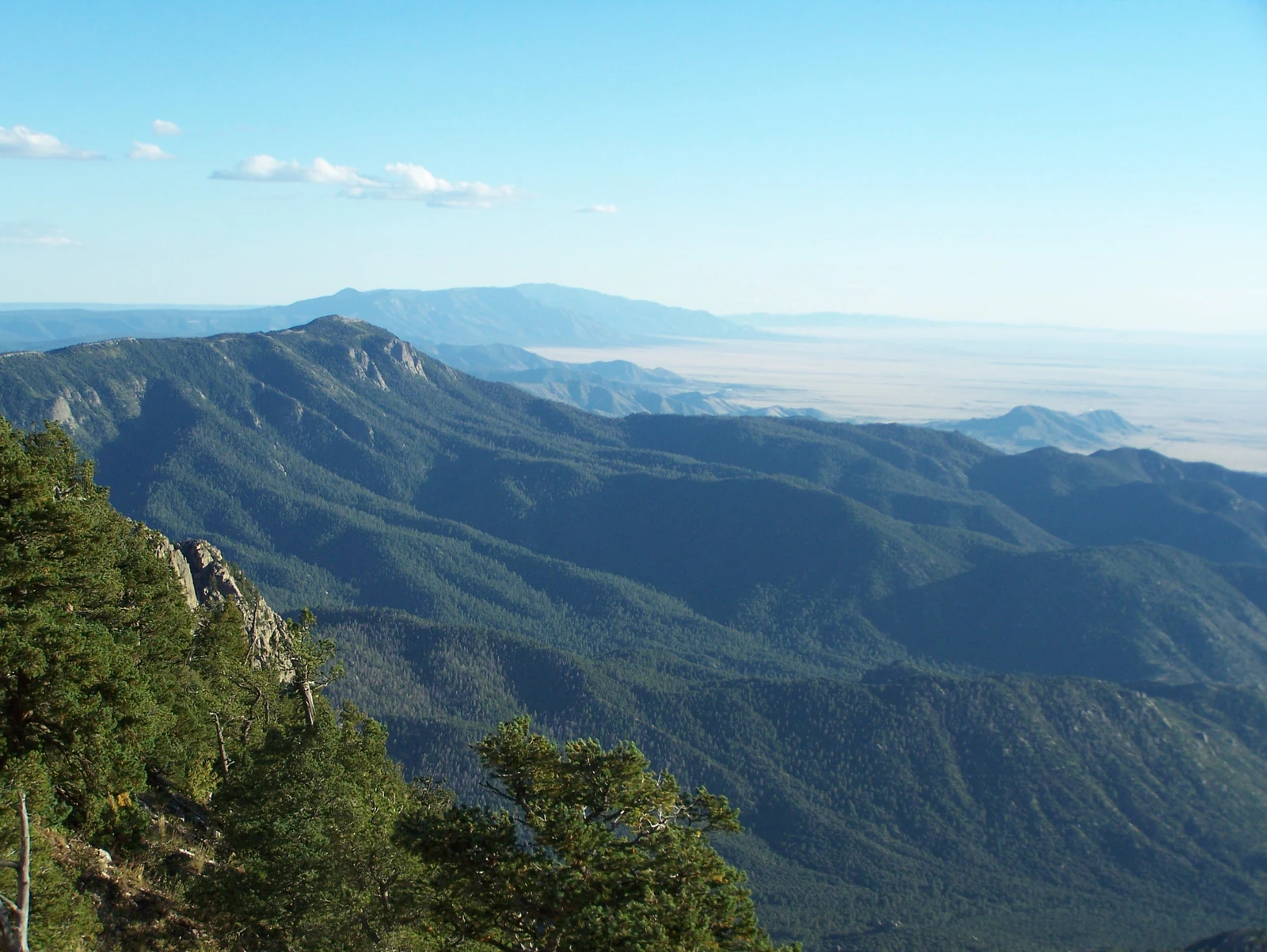
The Manzano Mountains from the north - the range that holds the old weapons-storage complex Bennewitz watched from Four Hills. Wikimedia Commons.
How the story spread
In 1984, Lawrence Fawcett and Barry Greenwood's Clear Intent put Bennewitz's relationship with the government in a book that UFO readers treated as a stack of documents, not a rumor. In 1988 the tabloid Weekly World News ran "UFO base found in New Mexico," quoting the crash-retrieval researcher Leonard Stringfield. Stringfield said he had never read such a distortion of facts in his life. In 1990 Howard Blum's Out There told a mass audience that undercover people had been sent to befriend Bennewitz with counterfeit documents. In 1992 a Monroe Institute article now sitting in the CIA's reading room named Moore and Doty in connection with a psychological destabilization program against him, and noted that documents in the matter carried Special Agent Doty's signature.[5]
Moore, meanwhile, was still in the house. West, following Bishop, writes that on one visit he found guns and knives everywhere, extra locks on the doors, and Bennewitz swearing that the aliens were coming through the walls at night and injecting him with chemicals. Moore was still going back to the Air Force with reports on how Bennewitz was taking it. At the same time he was sitting in that house watching the man get worse - on a story Moore himself had been handing him.
The night the house filled with sandbags
By August 1988 Bennewitz was accusing Cindy of being under extraterrestrial control. He tried to barricade the Four Hills house with sandbags. The family had him admitted to the mental-health unit at Presbyterian Anna Kaseman Hospital in Albuquerque, where he stayed about a month. Moore visited him there and tried to say that the material he had passed was disinformation. Bennewitz, by then, had treated Doty as a friend for years. The confession didn't undo the decade.
He came home quieter and didn't become a conference regular. Years later, when Greg Bishop was researching Project Beta, he called the family to ask about those years. Cindy told him not to call again.
On July 1, 1989, at the MUFON symposium in Las Vegas, Bill Moore stood up and told the room what he had done. He said he had been recruited to supply information on Bennewitz and that he had passed false material. People booed. Some walked out. The speech is on tape. It is one of the few moments in this whole decade where a participant said out loud what he had done, without blaming aliens for it.[6]
Video: William L. Moore, MUFON symposium, July 1, 1989 - the disinformation confession, complete lecture.[6]
In 1999 the Albuquerque Tribune ran the Bennewitzes on the anniversary page for fifty years of marriage. Paul died on June 23, 2003, at seventy-five, and was buried at Santa Fe National Cemetery. In 2005 Bishop published Project Beta. In 2010 Mark Pilkington published Mirage Men, and in 2013 the documentary of the same name put Doty on camera for a wider audience. The Dulce story didn't die with any of them. Other people kept telling it.
What can be checked, and what cannot
The parts that can actually be checked aren't wild. Bennewitz lived and worked on the edge of Kirtland and spent 1979-1980 filming and recording toward Manzano. He contacted the base on October 24, 1980, and briefed personnel on November 10. He sent the Dulce letter to Senator Domenici on December 2, 1981. Doty has repeatedly said he was assigned to mislead him. Moore said the same, in public, in 1989. A CIA-held 1992 article discusses a destabilization program and Doty-signed paperwork. In August 1988 Bennewitz was held about a month at Presbyterian Anna Kaseman. He died June 23, 2003.
What the lights and radio actually were is still open: classified test, conventional aircraft, a sensor or laser program Doty has mentioned, plasma, something else. Whether Myrna Hansen was a genuine witness, a hoaxer, or an asset is still open. How much of Dulce Bennewitz built from hypnosis and fear, and how much was handed to him, is still open. The U-2 "base in total detail" photos were claimed and have not been produced in public in a form that closes the case. The computer never yielded a message an outsider could check.
People usually take those facts one of three ways.
The first is the one Bishop made readable and the one Doty later prefers: Bennewitz stumbled onto tests or a sensor system at Kirtland - stealth work is the usual suspect; Doty has also mentioned a laser project - and AFOSI needed him looking at gray aliens instead of a real program. The lights were real. The alien story is what they used against him.
The second is Greg Valdez's. He argues the mutilations his father and Bennewitz chased were not aliens and not random. He ties them to follow-up on Project Gasbuggy, a 1967 underground nuclear shot about twenty-one miles southwest of Dulce, part of a program that tried to use bombs to loosen natural gas. In that reading, Bennewitz was dangerous because he was looking at carcasses and government land, not because he had found a saucer hangar. His book Dulce Base: The Truth and Evidence from the Case Files of Gabe Valdez is the place to follow that argument. The Gasbuggy shot itself - who fired it, what the well produced, and why the gas never went to market - is told here.
The third is the version still alive in parts of the UFO world: Bennewitz filmed something non-human, got too close to Dulce or to a real liaison program, and they did it to him on purpose. In that version Moore and Doty are just covering it up, not inventing it. That version has to explain why the "best" documents were the ones later admitted to be doctored, and why the computer conversations never produced a checkable line.
One more thing sits next to all three. Some of this started before the Air Force officially logged him. Back in May 1980, when Hansen first stayed at the house, Bennewitz and Sprinkle put her under in his Lincoln Town Car in the garage and wrapped the windows in foil because they thought alien beams would break the session. By June he already had a war story coming out of those regressions. Owning guns in the United States isn't strange. Carrying a pistol and a rifle because he thought aliens were about to hit the house is a different thing. You can argue he already leaned toward paranoia. That doesn't let anyone off the hook. Doty and Moore later said, in public, that they ran a campaign to mislead him. Whatever he brought into the room, they still worked him.
Why the story still matters
A lot of later American UFO stories about underground bases, secret treaties with aliens, and cattle mutilations come out of this case. John Lear, Bill Cooper, Phil Schneider, and years of forum posts picked up a story that AFOSI helped put into circulation. That doesn't make every later witness a mark. It does mean that if you're going to talk about Dulce, you have to talk about a deck in Four Hills, a Lincoln wrapped in foil, a special agent with fake documents, fake props on a hillside, and a man who started out trying to identify lights over a weapons mountain and ended up sandbagging his own living room.
He wanted the President to know. The people who already knew used him so attention would go to Dulce and not to whatever was actually flying over Kirtland. We still don't know what those lights were.
Sources
- Library of Congress. Publisher sample of Greg Bishop, Project Beta, chapter 1 - the deck, the Manzano complex, Thunder Scientific on the fence line, Bennewitz as an aerobatics pilot. catdir.loc.gov
- Grokipedia. "Paul Bennewitz." Useful first timeline (Hansen, Domenici letter, AFOSI, hospitalization, burial). The New Mexico witness Myrna Hansen has no solo encyclopedia page; this is the parent article. grokipedia.com/page/Myrna_Hansen is the 1953 Miss USA actress, a different person. grokipedia.com/page/Paul_Bennewitz
- Showtime. UFO - official clip, Richard Doty on the Kirtland assignment. Watch on YouTube (this clip does not play in an on-page embed). youtube.com/watch?v=kOT39FXstho
- West, Mark D. "Conspiracy Theory and the 'Bodyguard of Lies': The Bennewitz Matter." Social Epistemology Review and Reply Collective, 10 Aug. 2023. Academic walkthrough of Bishop: fake vents, cloud projections, the Ebans/Sweads narrative, Moore's house visits. social-epistemology.com
- CIA Freedom of Information Act Electronic Reading Room. "Will the Real Scott Jones Please Stand Up?" (Monroe Institute-related article discussing Bennewitz, Doty-signed documents, destabilization). cia.gov/readingroom
- Moore, William L. "UFOs and the U.S. Government." MUFON symposium lecture, 1 July 1989. Complete recording courtesy Ron Regehr. youtube.com/watch?v=dUfimKiS-po
- Bishop, Greg. Project Beta: The Story of Paul Bennewitz, National Security, and the Creation of a Modern UFO Myth. Paraview Pocket Books, 2005. The book to read first if this page is not enough. amazon.com
- Pilkington, Mark. Mirage Men: An Adventure into Paranoia, Espionage, Psychological Warfare, and UFOs. Skyhorse, 2010. Book on Amazon. Film: Lundberg, Denning, Kyprianou, dirs. Mirage Men (2013). Watch on Amazon
- Fawcett, Lawrence; Greenwood, Barry. Clear Intent: The Government Coverup of the UFO Experience. 1984. Early published account of Bennewitz's government relationship. Scan: archive.org
- Blum, Howard. Out There: The Government's Secret Quest for Extraterrestrials. 1990. Mass-audience version of the undercover-documents campaign. amazon.com
- Joe Mabel. Photograph of Kirtland Air Force Base, 26 Feb. 2015. Wikimedia Commons, CC BY 3.0.
- Greg Bishop interview on the New Mexico case and national-security context. youtube.com/watch?v=8sWUem4_Mfg
- News package on the FBI cattle-mutilation file and Senator Harrison Schmitt's 1979 New Mexico inquiry. youtube.com/watch?v=_Gq_zMYlufY
- Mutual UFO Network (MUFON). Official site of the civilian group that hosted Moore's 1989 speech. mufon.com
- Rose, Steve. "The real Men in Black, Hollywood and the great UFO cover-up." The Guardian, 14 Aug. 2014. Plain-language Mirage Men report: the plane, crashed-craft sightings, dumped props, signal-interpreting software. theguardian.com
- Valdez, Greg. Dulce Base: The Truth and Evidence from the Case Files of Gabe Valdez. 2013. Hansen-as-hoax argument; listening devices in Gabe Valdez's and Manuel Gomez's houses; NSA/CIA as the likely hands; Gasbuggy reading of the mutilations. amazon.com
- Gorightly, Adam. Saucers, Spooks and Kooks: UFO Disinformation in the Age of Aquarius. Daily Grail, 2021. Prints Greg Valdez on Hansen and on bugs at the house and the Jicarilla tribal police. amazon.com
- Bennewitz, Paul. "Project Beta." 1988 paper on how he thought the Dulce facility might be attacked. Primary document, not proof of a base. bibliotecapleyades.net
- Thunder Scientific. Company history page for the instrument shop Bennewitz founded. thunderscientific.com
- "Manzano Mountains from north." Photograph. Wikimedia Commons
- Barkun, Michael. A Culture of Conspiracy: Apocalyptic Visions in Contemporary America. University of California Press. Places Bennewitz and Project Beta in the wider Dulce literature. amazon.com
- Air Force Office of Special Investigations. Form 96, 26 Nov. 1980. "Alleged Sightings of Unidentified Aerial Lights in Restricted Test Range" - write-up of the 10 Nov. 1980 briefing. FOIA copy via OpenMinds. openminds.tv PDF
- Air Force Office of Special Investigations. Form 158, 30 July 1981. "Dr. Paul Fredrick Bennewitz Congressional Inquiry" - Domenici asks to see Doty, then meets Bennewitz. FOIA copy via OpenMinds. openminds.tv PDF
Further reading
← Back to 🛸 UAPs/UFOs
Related:
Cash-Landrum ·
Majestic 12 ·
Project Aquarius ·
Project Gasbuggy ·
Project Stargate ·
Skinwalker Ranch