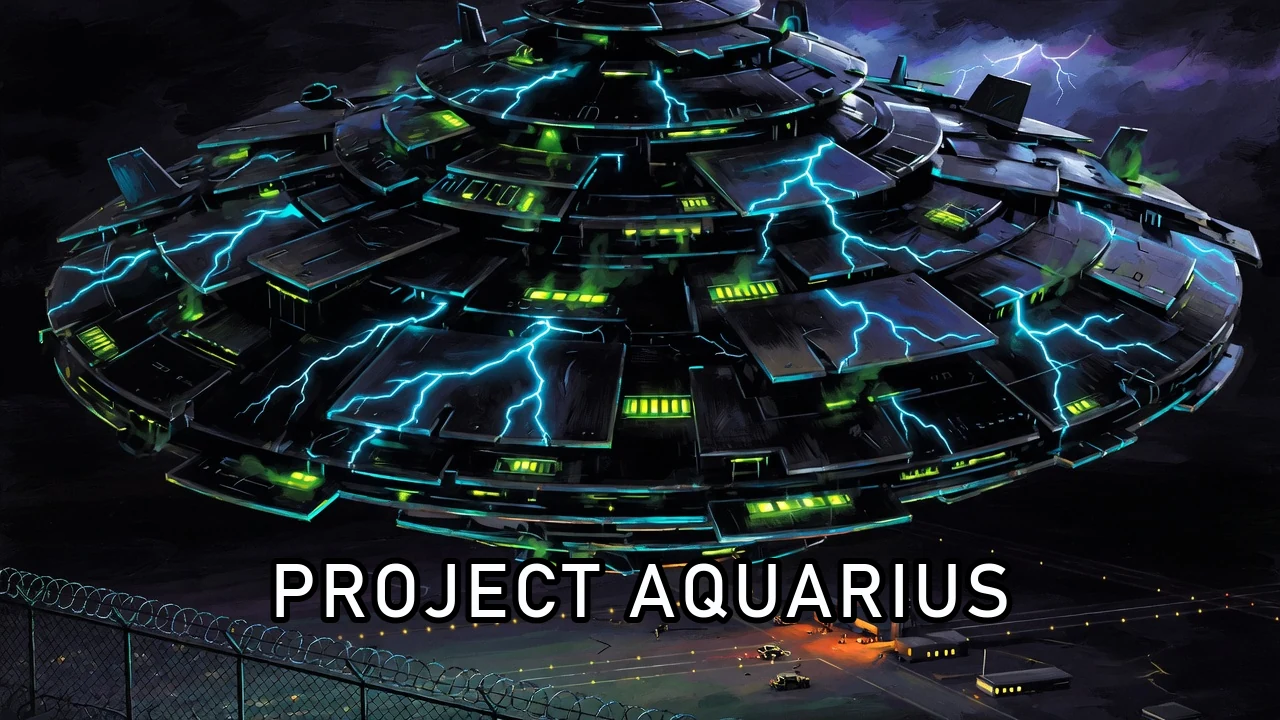
On November 17, 1980, a message that looked like Air Force counterintelligence traffic left Bolling Air Force Base in Washington and headed for the Air Force Office of Special Investigations office at Kirtland Air Force Base in Albuquerque - the huge New Mexico base that shares ground with Sandia National Laboratories and holds the Manzano weapons mountain.
The header said it was for AFOSI only. The body talked about film. Negatives of lights and objects, 8-millimeter footage, an analysis that called at least one frame a "legitimate negative of unidentified aerial object." Then, near the bottom, the line that would outlive the rest of the page: the official U.S. government policy and results of Project Aquarius were still classified Top Secret, with no dissemination outside official intelligence channels and with restricted access to "MJ Twelve."[1]
That is the first time those two names sit together on a paper that UFO researchers treated as a government leak. The man the message was really about had briefed the base a week earlier.
The man they were writing about
Paul Frederic Bennewitz Jr. was an Albuquerque instrument maker. He ran Thunder Scientific, a family shop that built temperature and humidity gear for NASA and the Air Force, and he lived in Four Hills, on the fence line of Kirtland. From the second-story deck he had been filming colored lights over the Manzano Weapons Storage Complex - then one of the largest underground stores of nuclear-weapons components in the Western world - since 1979. He also pointed antennas at the ridge and treated the radio as data.
On October 24, 1980, he called the base. On November 10 he went on post and put his film, stills, and tapes in front of officers from Kirtland, Sandia, and AFOSI. An AFOSI Form 96 dated November 26 says he claimed documented contact with the beings flying the objects and asked for money to keep going. Special Agent Richard C. Doty - the AFOSI man at Kirtland who later said his job was to mislead Bennewitz - told him on November 17 that AFOSI would not get involved. The same day, the Aquarius teletype is dated.[2]
Years later, Doty said supervisors didn't want a contractor going public claiming he had tapped a secret system at Kirtland. The safer story, as he later told it on camera, was a crazier one - aliens, an underground base, an invasion. A claim that wild is easy to laugh off. Film of a real test over a nuclear storage mountain is not. The Bennewitz story is told in full here. This article is regarding the paper that came out of that campaign.
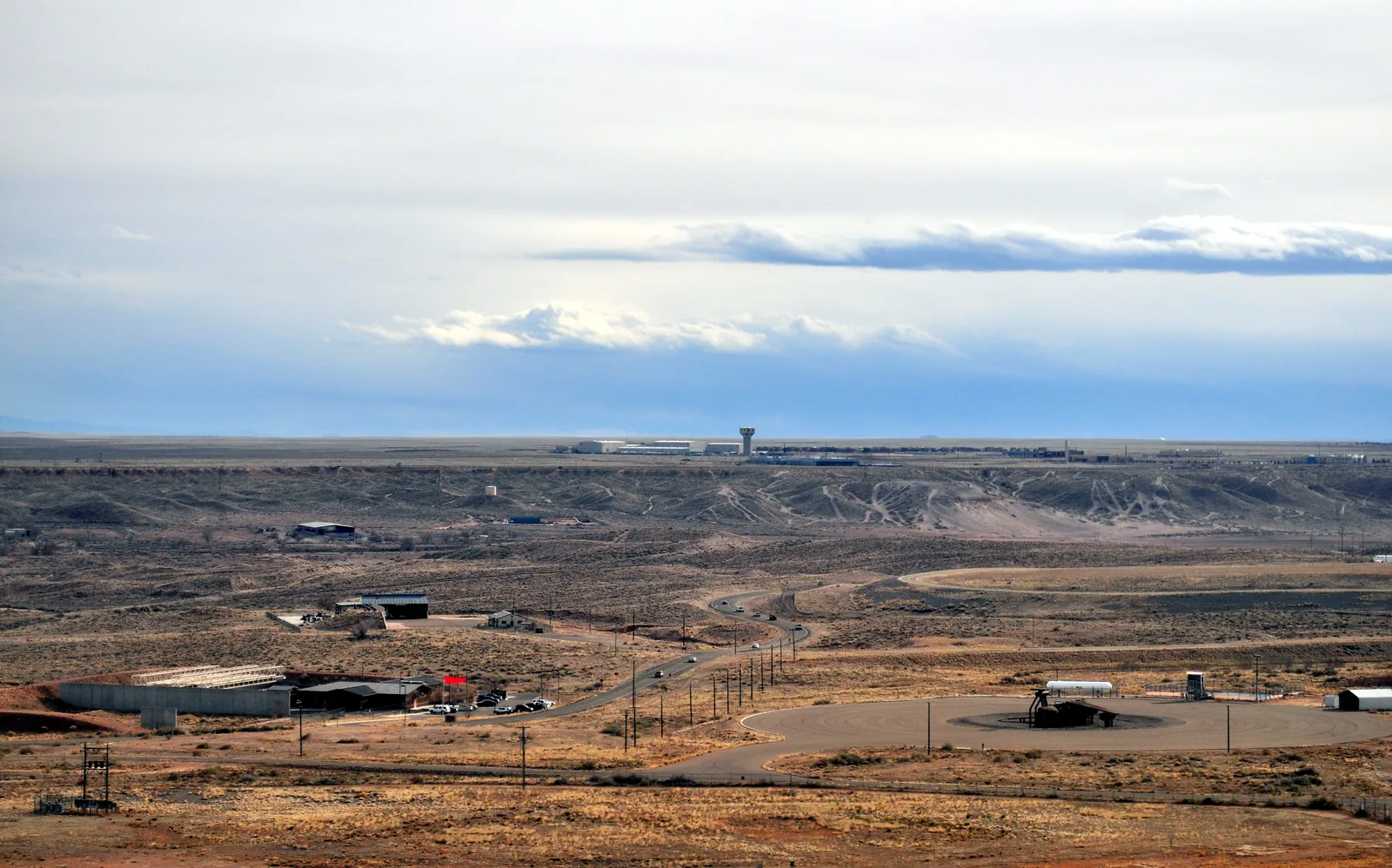
Kirtland from the south, 26 Feb. 2015 - hangars and ramps next to the Albuquerque airport runways. Photo by Joe Mabel. CC BY 3.0.
Who's who
A lot of names show up in this story. Here are the main ones, so it's easier to keep them straight.
- Paul Bennewitz - Albuquerque instrument maker. Filmed lights over Kirtland. The first person handed the Aquarius paper.
- Richard Doty - AFOSI special agent at Kirtland. Later said he fed Bennewitz false material. Showed Linda Howe a briefing paper in 1983.
- Bill Moore - UFO author. Said he passed a doctored Aquarius teletype. Later helped publicize the MJ-12 papers.
- Linda Moulton Howe - Denver documentary producer. In April 1983 Doty let her read, but not copy, a presidential briefing paper that named Aquarius.
- Jaime Shandera - Los Angeles TV producer. In December 1984 an anonymous roll of film with the MJ-12 briefing arrived at his house.
- Stanton Friedman - nuclear physicist and UFO lecturer who argued some of the later MJ-12 papers were real.
- Bob Pratt - National Enquirer reporter. In 1982 he drafted a novel with Moore and Doty first called MAJIK-12, then The Aquarius Project.
What the teletype said
The circulating copy is written like a TWX, the all-caps teletype style the Air Force used for traffic between offices. It answers a request from Kirtland dated October 29, 1980, for "photo imagery interpretation" on a case number that matches the Bennewitz file. It claims HQ and a unit called 7602 AINTELG at Fort Belvoir looked at several negatives and a strip of 8-millimeter film.
One frame, it says, showed a C-5A on approach and a streaking object that didn't match the aircraft in size. Another showed a cylinder. Thirty-four inches of film showed a colored object "within 152mm of the camera." A fifth negative was called a saucer about thirty-seven feet across with a "trilateral insignia" on the lower portion. Some of those conclusions are "inconclusive." Two are labeled legitimate pictures of an unidentified object. Then the message turns to talking about UFO policy.
The Air Force, it says, is no longer publicly active in UFO research, but still has interest in sightings over bases and test ranges. Several other agencies, "led by NASA," still investigate "through covert cover." One such cover is named as a UFO reporting center at the U.S. Coast and Geodetic Survey in Rockville, Maryland. NASA filters the results to the military. And then the Aquarius sentence, with the misspelling that later researchers never stopped pointing at: "NO DISEMINATION OUTSIDE OFFICIAL INTELLIGENCE CHANNELS." The Bennewitz case, the last operational line says, is being monitored by NASA, and future evidence should go to them through AFOSI.[1]
If you had never seen a real AFOSI message, it looked like gold. If you had, the extra paragraph sat on the page a little too neatly.
Video: Decoding the Unknown on the MJ-12 leak, including the earlier Aquarius telex that first put "MJ Twelve" on a circulating page.[21]
A real form, and a retyped one
There is a second Kirtland paper from the same weeks that is easier to place. On September 2-9, 1980, Doty signed an AFOSI complaint form about lights over the Manzano storage area and Coyote Canyon, the restricted test ground on the far side of the same mountain. Security policemen described a bright light that stopped, landed, and went straight up. A Sandia guard later said he had walked toward a round disk-shaped object with a shotgun and that his radio would not work. On August 13, radar approach control at Kirtland and the civilian Albuquerque airport went dark for hours from high-frequency jamming that nobody would own up to. Those complaint forms were released under the Freedom of Information Act and are the ground the teletype pretends to stand on.[1]
The Aquarius teletype is a different object. William L. "Bill" Moore, the UFO author who had just published The Roswell Incident with Charles Berlitz, later said Doty showed him a real AFOSI message right off the teletype and then came back with a copy that was not the same. Material had been added. Moore said NASA, in the circulating version, had been NSA in the original - the National Security Agency, the signals-intelligence service at Fort Meade - and that the Coast and Geodetic Survey cover was bogus. He understood he was being asked to hand a doctored paper to Bennewitz.
He sat on it. Then he worried that the sources he thought he was developing would dry up if he didn't cooperate, and he gave Bennewitz the altered copy and asked him not to publicize it. Bennewitz kept that promise. In September 1982, during a trip to San Francisco, someone broke into Moore's car and stole the briefcase that held another copy. Four months later the teletype was in the hands of a New York lawyer who collected UFO documents, and then it was everywhere.[3]
When KPIX-TV in San Francisco later asked the Air Force about an "MJ Twelve" memo Moore had shared, the Air Force noted style and formatting errors. Moore admitted he had typed and stamped a facsimile. The circulating Aquarius page is that kind of object: a real case number on a page that looks like official traffic, and a last paragraph that someone wanted Bennewitz - and then everyone else - to believe.
The briefing she was not allowed to copy
In the fall of 1982, Linda Moulton Howe was a Denver documentary producer who had already won a regional Emmy for A Strange Harvest, her 1980 film on cattle found dead with clean cuts and little blood. Home Box Office asked her to make a UFO film. Peter Gersten, the attorney who ran Citizens Against UFO Secrecy, the FOIA group that had been suing agencies for UFO files, told her Doty might talk. She flew to Albuquerque on April 9, 1983.
Doty was not at the airport. Jerry Miller, a Kirtland scientific advisor and former Project Blue Book investigator who had already sat in Bennewitz's living room, picked her up and called Doty's house. At the base Doty took her to a small building, moved her chair to the middle of the room, and said people could see in through the windows. Then he took a brown envelope from a desk drawer and handed her several sheets titled, as she later remembered it, a briefing paper for the President of the United States on unidentified flying vehicles. She was allowed to read the document, but not allowed to copy it.
The paper, as she reconstructed it in An Alien Harvest (1989), listed crash dates and gray-skinned bodies three and a half to four feet tall. It used the phrase extraterrestrial biological entities, EBEs. It said one living being, later called EBE-1, had been held at Los Alamos and had died in 1952. It named projects: Snowbird for a craft the visitors had left as a gift, Sigma for electronic communication, a dead project called Garnet on whether those visitors had steered human evolution, and Aquarius as the umbrella that held the rest. It said Blue Book had existed to take heat off the Air Force. Doty told her "MJ" stood for "Majority," a twelve-person policy group. He promised thousands of feet of film of crashed discs, bodies, and a Holloman Air Force Base landing. HBO wanted a letter of intent from the government. The letter never came. The interview with the colonel who had supposedly lived with EBE-1 was scheduled and canceled. By October the calls had slowed. Her HBO contract expired.[3]
In 1988 Doty wrote another researcher and denied that the meeting had happened that way. Howe answered with a sworn statement and her correspondence from the period with Doty and HBO. Moore, in 1989, said Howe had been caught in a counterintelligence sting aimed at the Bennewitz problem. If her HBO film mentioned the electromagnetic work around Coyote Canyon, other people - including, he said, the Russians - might try the same experiment.
He also said Doty had added another crash to the paper Howe saw. In 1948 a story went around that a flying saucer had come down near Aztec, New Mexico, a small town in the northwest corner of the state. Frank Scully, a Hollywood columnist, put it in a 1950 book, Behind the Flying Saucers. The tale later fell apart. The men who sold it to Scully were confidence men, and Moore himself had been working to show the Aztec crash never happened. He said Doty stuck that story in after hearing him talk about it. If that is true, the briefing Howe held for an hour already contained a crash that didn't happen, sitting next to Roswell as if both belonged in the same file.
They wrote it as a novel first
The year before Howe's visit, Moore had already been trying to get the same story into a book. He asked Bob Pratt, a National Enquirer reporter who had spent years on UFO cases, to help him write what started as nonfiction and became a novel when they didn't have the documents to support it. Pratt's working title was MAJIK-12. Moore changed it to The Aquarius Project. On a phone call about the manuscript, Moore told Pratt the point was to get as much of the story out with as little fiction as possible. The book was never published. Pratt kept the tapes. In 2007, researchers Brad Sparks and Barry Greenwood used them to show that Moore and Doty were already talking about "MJ-12" and "Aquarius" two years before the famous film arrived in a mailbox.[4]
That matters because of what happened next. In mid-December 1984, Jaime Shandera, a Los Angeles television producer working with Moore, got an anonymous package with a New Mexico postmark and a roll of undeveloped 35-millimeter film. The frames were a purported November 18, 1952, briefing for president-elect Dwight Eisenhower on Operation Majestic-12, a twelve-man committee President Truman had supposedly created in 1947 to handle a New Mexico crash and the bodies that came with it. Moore, Shandera, and Stanton T. Friedman sat on the paper until the spring of 1987, when British writer Timothy Good also had a copy and the London papers ran it. The Aquarius teletype had already taught the field the name. The Eisenhower briefing gave the name a 1947 birthday, a membership list, and a Roswell origin story.
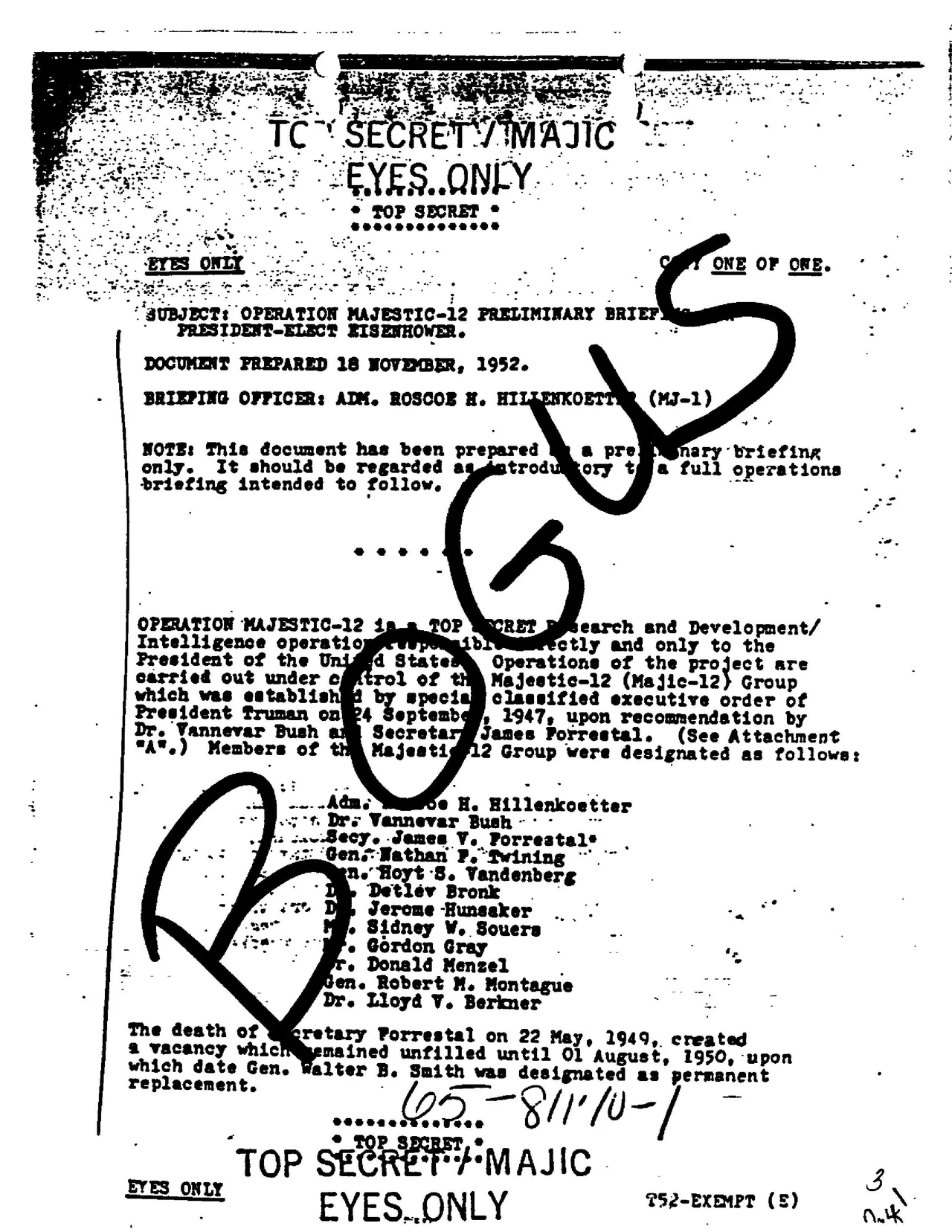
The later MJ-12 briefing, as it sat in an FBI file. The Bureau forwarded copies to AFOSI and closed the matter as "completely bogus." FBI / Wikimedia Commons, public domain. Full file: vault.fbi.gov.
The name that was already in a filing cabinet
While UFO researchers were treating Aquarius as a secret alien-history project, the Defense Department already had a file with that title, and it was about radar.
From June 1969 to May 1971, Sylvania Electronic Systems in Mountain View, California, ran a contract for the Advanced Research Projects Agency - ARPA, the Pentagon research shop later called DARPA - under ARPA Order 1459. The cover says Project Aquarius Final Report. The project engineer is listed as K. Snow. The contract was $118,864, monitored by the Office of Naval Research. The opening paragraph is not about visitors. "Project AQUARIUS is a part of the Advanced Research Projects Agency (ARPA) sponsored ocean surveillance and tactical early warning program under Project MAY BELL." The job was to see whether high-frequency radar, bouncing off the ocean and the ionosphere, could detect aircraft, ships, and submarine-launched ballistic missiles past the horizon. There are diagrams of buoys, Mediterranean coverage, and fleet air defense. There are no EBEs.[5]
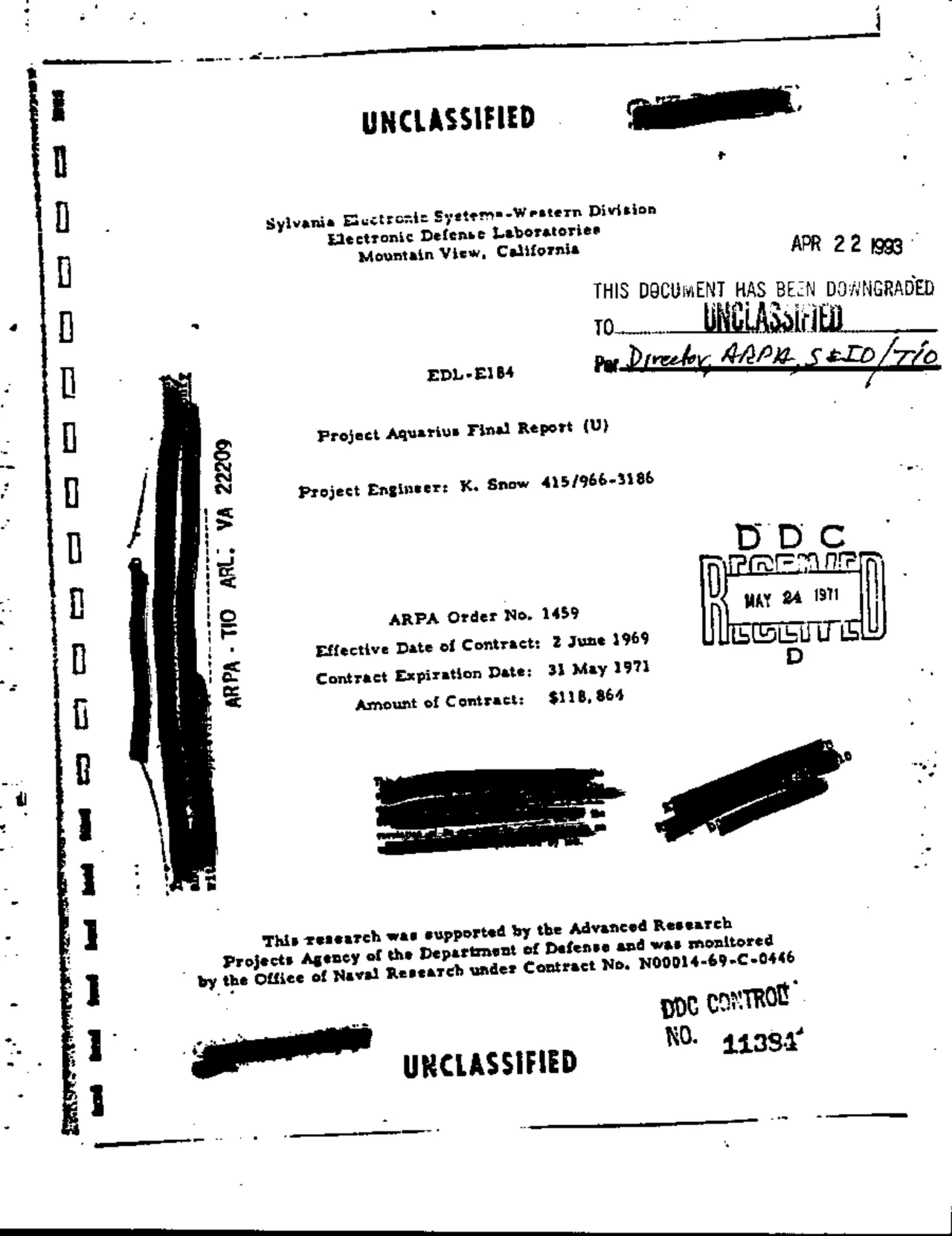
The Project Aquarius that is actually in the Defense Technical Information Center: a 1969-1971 ARPA/Sylvania study of over-the-horizon radar, not a UFO brief. Scan via The Black Vault.
That is the boring middle of this story, and it is why the later FOIA fight went the way it did. When researchers asked the National Security Agency for "Project Aquarius" and meant aliens, the computers had a reason to return a hit.
What NSA would put on letterhead
In 1985 and 1986, Seattle researcher Christian Lambright and the Computer UFO Network pressed NSA under FOIA. On March 3, 1986, Dennis C. Chadwick, NSA's chief of information policy, wrote that Project Aquarius "does not deal with unidentified aerial objects," and that Sigma and Snowbird were not NSA projects at all. When Lambright narrowed the request to the "goal" of Aquarius, Julia B. Wetzel, NSA's director of policy, answered on April 15, 1986. A document had been found. It was currently and properly classified Top Secret. Disclosure "could reasonably be expected to cause exceptionally grave damage to the national security." No portion was reasonably segregable. The search fee for a wider hunt had been quoted at $15,000.[1]
On January 27, 1987, Wetzel wrote Senator John Glenn about a constituent who kept asking questions. The letter is the clearest official sentence in the whole file. Project Aquarius, she said, had been the subject of numerous FOIA requests. "Apparently there is or was an Air Force project by that name which dealt with UFO's. Coincidentally, there is also an NSA project by that name. The NSA project does not deal with UFO's." She thought the confusion started with Lambright, who had asked for the NSA project believing it was about flying saucers, been told it was not, asked for the goal, and then watched the denial letter travel through the UFO circuit as if it were a confession.[1]
On June 25, 1987, at the National Press Club, Dale Goudie and Lambright held a press conference they called the "Ice Documents" briefing, after the Chadwick letter that had "broken the ice" by admitting a Project Aquarius existed. They treated Wetzel's Glenn letter as proof that the Air Force's Aquarius did deal with UFOs, and they put the November 17 teletype on the table next to the Kirtland complaint forms. The Air Force, asked about those project names on national television, had said they didn't exist. The NSA letters said a classified Aquarius did exist and was not about UFOs. Both things can be true at once if the name was reused, or if someone at NSA was politely pointing at the Air Force telex without authenticating it. The press conference did not settle which.
The National Archives, later answering a flood of MJ-12 questions, searched Air Force, Joint Chiefs, Truman Library, Eisenhower Library, and National Security Council indexes under MJ-12, majestic, unidentified flying objects, UFO, flying saucers, extraterrestrial biological entities, and Aquarius. Those searches were negative except for one page: a July 14, 1954, memo from Eisenhower aide Robert Cutler to General Nathan Twining about an "NSC/MJ-12 Special Studies Project" briefing. The memo does not say what MJ-12 was. Archivists have spent decades pointing out that it was found after anonymous tips told Moore and Shandera which box to open, and that Cutler was out of the country on the date he supposedly signed it.[6]
The Bureau closes the later file
In September 1988 an AFOSI agent in Dallas called the FBI after someone at a school mailed in the Eisenhower briefing. AFOSI told the Bureau on November 30 that no such committee had ever been authorized. The FBI stamped the papers "completely bogus" and shut the case. Emma Best, writing years later for MuckRock, noted that the Bureau never tried to find the forger, even though forging government documents is a crime it could have charged. That gap is why some people still read the file as tolerated disinformation rather than a civilian hoax the government simply didn't want to litigate.[7]
Video: ABC Nightline, 24 June 1987 - Stanton Friedman and Philip J. Klass argue the MJ-12 papers with Ted Koppel, weeks after the documents went public.[22]
On July 1, 1989, at the MUFON symposium in Las Vegas, Moore stood up and told the room he had been recruited to report on Bennewitz and that he had passed false material. People booed. Some walked out. The speech is on tape - the full hour is on the Bennewitz page. It is the moment the Aquarius paper stops being only a mystery document and becomes something a participant would own, in public, as a lie he had helped move.[8]
What can be checked, and what cannot
The parts that can actually be checked are not wild. Bennewitz briefed Kirtland on November 10, 1980. A teletype dated November 17, naming Project Aquarius and MJ Twelve, circulated from that case and was the first widely shared paper to use the MJ-12 name. Moore said it was a retyped real message with UFO language added, and that he gave the doctored copy to Bennewitz. Howe said Doty showed her a presidential briefing in April 1983 that used the same project names. Moore and Pratt drafted a novel called The Aquarius Project in 1982. Shandera's film arrived in December 1984. The FBI called the later MJ-12 set bogus in 1988. A real ARPA contract titled Project Aquarius ran from 1969 to 1971 and was about over-the-horizon radar. NSA told a senator in 1987 that its own Aquarius was not about UFOs, and that it believed the Air Force might have used the name that way.
Video: Brian Dunning, Skeptoid #528 - "The Secret History of Majestic 12." A short walk through the paper trail, including Moore's suspicion that the documents were Air Force disinformation rather than a civilian hoax.[23]
People usually take those facts one of three ways.
The first is Moore's later version, the one Greg Bishop made readable in Project Beta and Mark Pilkington followed in Mirage Men: AFOSI needed Bennewitz looking at gray aliens instead of a real test or sensor program at Kirtland, so they handed him official-looking paper. Aquarius and MJ-12 were bait. The later film in Shandera's mailbox was either the same shop continuing the game or researchers finishing a story they had already been writing as fiction.
The second is the 1987 CUFON reading. NSA admitted a classified Project Aquarius. Wetzel told Glenn the Air Force had, or had had, a project by that name that dealt with UFOs. The Kirtland complaint forms describe lights over a nuclear storage area. In that version the teletype is a sloppy leak of a real compartment, and the radar contract is either a cover name or a coincidence someone was happy to hide behind.
The third is still alive on forums: the Aquarius executive briefings that later circulated - the long ones that list Snowbird, Sigma, Plato, and a 25,000-year alien history - are the real program, and Moore's confession is more cover. That version has to explain why the first paper was a retype Moore said he sat on, why Howe was not allowed to leave with a copy, why Pratt was asked to novelize the same plot in 1982, and why the one Project Aquarius report you can actually download from a Defense Department clearinghouse is about buoys and skywave radar.
What is still open is narrower than any of those speeches. Who typed the extra sentences onto the November 17 message is still open. How much of Howe's hour in the office was Doty freelancing, and how much was a written brief someone else prepared, is still open. What document NSA withheld in 1986 as the "goal" of its Aquarius - the radar study, a SIGINT program that reused the name, or something else - is still open, because they never released it. Whether anyone above Doty signed off on using a live classified project name as bait is still open.
Why the paper still matters
Almost every later American story about a secret committee that recovers craft, a project that compiles alien history, and a live EBE in a safe house runs through this file. John Lear's 1980s mailings, Bill Cooper's shortwave, the Dulce underground-base legend that grew out of the Bennewitz years, and the MJ-12 debates that still restart every time a new UAP hearing makes the news all inherited a vocabulary that first showed up as a last paragraph on a Kirtland teletype.
Bennewitz wanted the Air Force to look at his film. The people who already knew he was watching the mountain gave him a program name, a committee name, and a finished alien history - treaties, recovered bodies, a live visitor in a safe house - and then watched both names leave the house. We still don't know who wrote the extra lines. We do know the radar report is real, the FBI called the later committee papers bogus, and Moore said, in a room full of the people who had believed him, that he had passed fake material on purpose.
Sources
- Computer UFO Network. "The Ice Documents Press Conference," National Press Club, 25 June 1987. Transcript of the Aquarius teletype, the Chadwick and Wetzel NSA letters, Wetzel's letter to Sen. John Glenn, and the September 1980 Kirtland AFOSI complaint forms. cufon.org
- Air Force Office of Special Investigations. Form 96, 26 Nov. 1980. "Alleged Sightings of Unidentified Aerial Lights in Restricted Test Range" - write-up of Bennewitz's 10 Nov. 1980 briefing. FOIA copy via OpenMinds. openminds.tv PDF
- Clark, Jerome. "Extraterrestrial Biological Entities." From UFOs in the 1980s. The long contemporary walkthrough of the teletype, Moore's account of the retype, Howe's April 1983 reading, and the stolen briefcase. sacred-texts.com
- Grokipedia. "Majestic 12." Useful for the Pratt novel title change, the 1987 public release, and the FBI "completely bogus" close. grokipedia.com/page/Majestic_12
- Sylvania Electronic Systems / ARPA. Project Aquarius Final Report, contract N00014-69-C-0446, 1969-1971. The real program: ocean surveillance and over-the-horizon HF radar under Project MAY BELL. Scan hosted by The Black Vault. theblackvault.com PDF
- National Archives. "Project BLUE BOOK - Unidentified Flying Objects," including the MJ-12 reference report. Searches of NSC indexes under Aquarius and related terms were negative except the disputed Cutler-Twining memo. archives.gov
- Federal Bureau of Investigation. The Vault: Majestic 12. The 1988 submission, AFOSI's "completely bogus" finding, and the closed file. vault.fbi.gov
- Moore, William L. "UFOs and the U.S. Government." MUFON symposium lecture, 1 July 1989. Complete recording courtesy Ron Regehr. youtube.com/watch?v=dUfimKiS-po
- Bishop, Greg. Project Beta: The Story of Paul Bennewitz, National Security, and the Creation of a Modern UFO Myth. Paraview Pocket Books, 2005. The book to read first for the human campaign the paper came out of. amazon.com
- Pilkington, Mark. Mirage Men: An Adventure into Paranoia, Espionage, Psychological Warfare, and UFOs. Skyhorse, 2010. Book on Amazon. Film: Lundberg, Denning, Kyprianou, dirs. Mirage Men (2013). Watch on Amazon
- Howe, Linda Moulton. A Strange Harvest (1980). Emmy-winning documentary that led HBO to hire her for the UFO film Doty later derailed. Watch on Amazon Prime Video. Book: An Alien Harvest (1989), her reconstruction of the unread-aloud briefing at Kirtland. amazon.com
- Friedman, Stanton T. Top Secret/Majic. Marlowe, 1996. The case for authenticity from the physicist who sat with Moore and Shandera. amazon.com
- Grokipedia. "Majestic 12." First-timer map of the later document set. The Aquarius teletype itself has no solo encyclopedia page. grokipedia.com/page/Majestic_12
- Grokipedia. "Paul Bennewitz." Parent article for the man the teletype was written around. grokipedia.com/page/Paul_Bennewitz
- Mutual UFO Network (MUFON). Official site of the civilian group that hosted Moore's 1989 speech. mufon.com
- North-Best, Emma. "Conspiracy Weary: FBI's real-life 'X-Files' document one of the Bureau's laziest investigations." MuckRock, 5 June 2017. On the closed MJ-12 file and the missing hunt for a forger. muckrock.com
- Blum, Howard. Out There: The Government's Secret Quest for Extraterrestrials. 1990. Mass-audience version of the undercover-documents years. amazon.com
- Wikipedia. "UFO reports and disinformation." Places the Aquarius telex as the earliest widely circulated "MJ Twelve" reference in the Bennewitz campaign. en.wikipedia.org
- Joe Mabel. Aerial photograph of Kirtland Air Force Base from the south, 26 Feb. 2015. Wikimedia Commons, CC BY 3.0
- Federal Bureau of Investigation. Crop of the alleged Majestic 12 memo as received in 1988. Wikimedia Commons, public domain
- Decoding the Unknown. "Operation Majestic 12: The Document Leak That Spawned a Thousand Conspiracy Theories." Long walk through the leak, including the Aquarius telex. youtube.com/watch?v=6fMNn4f07S8
- ABC Nightline. Stanton Friedman and Philip J. Klass, 24 June 1987. Posted by Eyes On Cinema. youtube.com/watch?v=AW6xj9xCs_8
- Dunning, Brian. "The Secret History of Majestic 12." Skeptoid #528, 19 July 2016. youtube.com/watch?v=Tv8Jcpc5rA0 Transcript: skeptoid.com/episodes/4528
Further reading
← Back to 🛸 UAPs/UFOs
Related:
Majestic 12 ·
Paul Bennewitz ·
Project Stargate ·
Rendlesham Forest