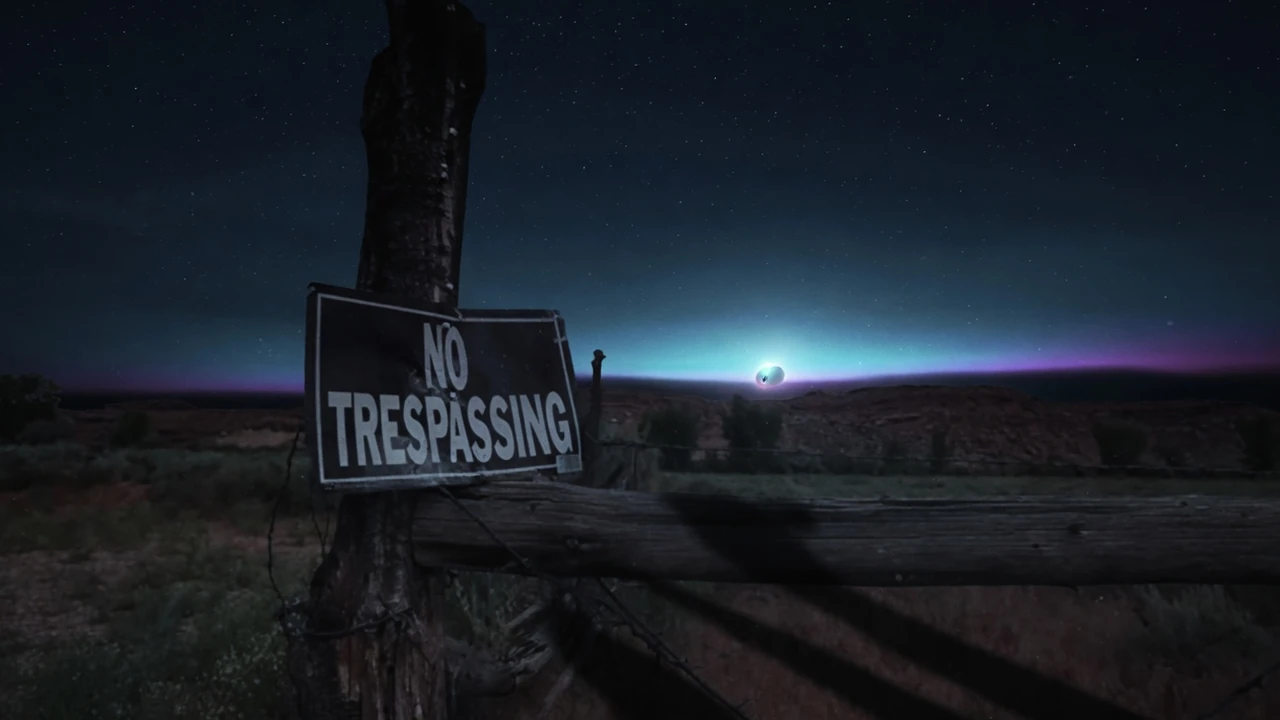
Southeast of Ballard in Utah's Uintah Basin, a few hundred acres of high desert sit under a red rock mesa. Cattle country. Reservation land nearby. Stars hard enough to cut glass on a clear night.
In the mid-1990s, the place stopped behaving like a normal ranch in the stories of the family that owned it. Lights that were not planes. Cattle that died wrong or vanished wrong. Voices. A wolf that would not die when shot. By summer 1996, the Deseret News had put the Shermans on the record. By autumn, aerospace entrepreneur Robert Bigelow had bought the property for roughly $200,000 and turned it into a privately funded anomaly laboratory.[1][2]
The world now calls it Skinwalker Ranch - a name borrowed from Navajo witchcraft lore (yee naaldlooshii) and pressed onto Ute-basin geography in a way ethnographers would handle with tongs. The file is not one night of lights. It is decades of high-strangeness claims, instrument campaigns, books, a DIA-linked program, and a History Channel afterlife.
How we got here
Long before the brand name, the Uintah Basin already had a reputation - UFO alley talk, cattle mutilation lore, settler oddities. The specific ranch had been Myers family cattle land for generations. Pre-1994 owners have been cited denying the cinematic haunting package later attached to the acreage. That tension never leaves the case: is the ranch special, or did a special story find a ranch?
In March 1994, Terry and Gwen Sherman (sometimes called the Gormans in later books) buy the property to raise cattle. In the family's public account, anomalies escalate fast - an early box-like hovering object with a beam, craft of several sizes, orange "doorways" in air, grass circles, soil impressions, and livestock deaths and disappearances. They say they videotaped some aerial events.
On June 30, 1996, Zack Van Eyck's Deseret News piece "Frequent Fliers?" puts the Shermans on the record - craft descriptions, mutilation details (precise damage, little blood, missing animals), and the wider basin context. Skepticism is already in the room; so is national curiosity in a summer when alien blockbusters were cultural weather.[1]
In September 1996, Bigelow closes on the ranch. October coverage describes his plan: the National Institute for Discovery Science (NIDS), sensors, scientists, round-the-clock attention. The Shermans move on; Terry briefly works as caretaker under nondisclosure. The property becomes a closed research site rather than a press zoo.[2]
NIDS work through the late 1990s and early 2000s - with biochemist Colm Kelleher as a central on-the-ground figure - is the spine of the 2005 book Hunt for the Skinwalker by Kelleher and journalist George Knapp. The book's thesis is not "we caught a spaceship." It is closer to: we watched a place produce intermittent, tricksterish events that refused to pose for peer review.[3]
Then the story leaves the pasture. DIA officer James Lacatski visits in the Bigelow era, later helps stand up the Advanced Aerospace Weapon System Applications Program (AAWSAP) - a DIA contract awarded in 2008 to Bigelow's BAASS, with total funding often cited around $22 million. Ranch high-strangeness becomes one thread in a Pentagon-adjacent UAP research knot that also produced dozens of technical papers on exotic aerospace concepts. The Black Vault's FOIA releases of the solicitation, contract trail, and Defense Intelligence Reference Documents (DIRDs) are the public paper trail for that era.[4]
The 2021 book Skinwalkers at the Pentagon (Lacatski, Kelleher, Knapp) is the insider narrative of that period - DoD-cleared for release, not DoD-endorsed as truth. From 2016 onward, real-estate executive Brandon Fugal (via Adamantium holdings) takes ownership. Instruments get louder. Television arrives - The Secret of Skinwalker Ranch - and the property becomes both research claim and entertainment product. Those are not the same job.[5]
Video: 8 News Now / Mystery Wire - George Knapp with Brandon Fugal on the ranch. News package, not a lab notebook.[6]
What people claimed
If you give the extraordinary version its best day in court, it sounds like this:
The ranch sits on or near a persistent anomaly - call it a hotspot, a thin place, a non-human intelligence playground, or a geophysical carnival that interacts with observers. Phenomena are multi-modal: UAPs and craft of several classes; blue or other colored orbs that approach animals and people; cattle mutilations that look surgical and bloodless; cryptid-class animals including a massive wolf-like creature Terry Sherman said he shot at close range with a .357 without normal effect; electromagnetic weirdness; radiation spikes; voices; poltergeist-like interior events.
NIDS investigators add their own nights. Kelleher's accounts include a large humanoid figure with yellow eyes in a tree and a clawed track in snow that did not lead to a tidy follow-up specimen. Later AAWSAP-era storytelling emphasizes the so-called hitchhiker effect - activity that reportedly follows visitors home as orbs, shadow figures, health complaints, and household disturbances, sometimes spreading to people who never visited the ranch.
Under this reading, the elusiveness is not a bug. It is the signature. Whatever is there does not want to be a Nature paper.
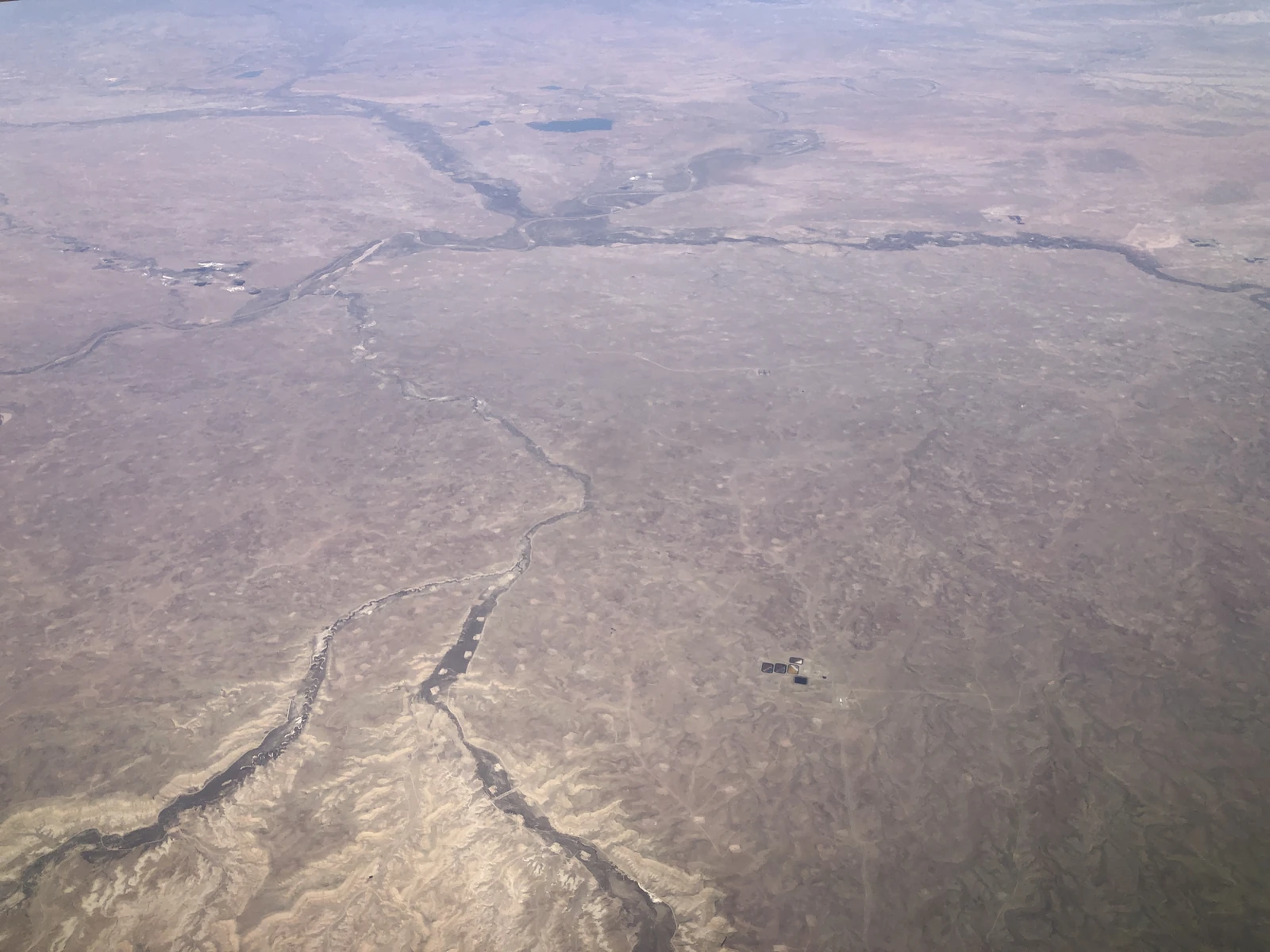
Uintah County from the air, March 2022 - the basin the ranch sits in, not a shot of the acreage itself. Photo by Famartin, CC BY-SA 4.0.
The evidence map
What's relatively solid:
- Ownership timeline is public enough: Shermans (1994-96), Bigelow/NIDS era, Fugal era (2016-).
- Contemporaneous 1996 Deseret News reporting on Sherman claims and Bigelow's purchase - primary journalism, not only later memoir.
- NIDS was a real privately funded effort with named scientists; Hunt for the Skinwalker (2005) is the main longform narrative of that period.
- AAWSAP/BAASS was a real DIA contract vehicle; DIRDs and program paperwork entered the FOIA ecosystem via The Black Vault and related releases.
- The Uintah Basin's broader UFO and mutilation folklore predates the Sherman tenure - the ranch is not floating in a cultural vacuum.
What's weaker or disputed:
- Reproducible, peer-reviewed demonstration of non-mundane causation on the property.
- Chain-of-custody public release of the strongest claimed sensor events in forms outsiders can reanalyze cold.
- How much TV-era experimentation is discovery versus production pressure.
- Hitchhiker-effect medical and household claims - intense, hard to audit, easy to contaminate with expectation.
- The "skinwalker" label itself - Navajo cultural material mapped onto Ute-basin real estate and entertainment branding.
Even the NIDS-era book is blunt about the hard-proof gap. After years of family trauma and focused investigation, Kelleher and Knapp describe very little physical evidence that could count as conclusive proof of anything - a sentence skeptics quote often, and fairly.[7]
Honest map: this is one of the most investigated strange places in modern American anomaly culture, and still one of the least settled. Money and instruments were not enough to force a single agreed mechanism.
Competing explanations
1. Genuine multi-modal anomaly / non-human intelligence. Decades of multi-witness claims, some physical traces (mutilations, tracks, soil features), instrument transients, and continuity from private science into government-adjacent interest. Kelleher and Knapp frame a "trickster" intelligence that interacts with observers. AAWSAP's willingness to study ranch strangeness alongside aerospace unknowns is offered as institutional smoke worth respecting.
2. Folklore amplification + misperception + ordinary ranch hazards. Prior long-term owners without the mythos; cattle deaths that can be predation, disease, or human cruelty misread as ritual precision; lights that are aircraft, flares, or plasma; expectation effects once a property is labeled cursed. Critics such as Robert Sheaffer have long argued the hard public proof never arrived despite years of watching - and that the simplest story may be invention or exaggeration meeting a willing buyer.
3. Geophysical and environmental oddities without spooks. Basin geology, gas, magnetite, subsurface voids, radon, infrasound, and equipment artifacts can generate real sensor spikes and unease without requiring witches or visitors. This lane takes instrument claims seriously and still refuses the cryptid ending.
4. Incentives and narrative industry. A billionaire's research brand, book deals, cable television, and UAP politics all reward signal. That does not automatically fake every event - it does mean every spectacular claim arrives pre-monetized. Separate the 1996 newspaper file from the 2020s episode structure before you merge them into one creature feature.
5. Mixed file. Some livestock and light events may be mundane; some witness nights may be sincerely unexplained; government interest may track aerospace security more than ghosts; the hitchhiker layer may be psychological contagion, overlooked medical issues, or something stranger. Collapsing everything into "all real aliens" or "all liars" is how the argument dies.
What is known vs. still open
Known with reasonable confidence
- Location: Uintah County, Utah, high-desert ranch property associated with a prominent mesa; roughly 512 acres in common modern figures.
- Sherman-era public claims hit newspapers in 1996; Bigelow purchase and NIDS plans are contemporaneously reported.
- NIDS investigation and later BAASS/AAWSAP connections are documented in books, participant accounts, and FOIA contract/DIRD releases.
- No consensus scientific validation of a single exotic cause has been established in the open literature.
Still open / unresolved
- Whether any class of ranch events requires physics beyond known misperception, fraud, and geology.
- How to weight hitchhiker reports without medical-grade longitudinal study.
- What AAWSAP field product specific to the ranch would look like if fully public and independently re-scored.
- How much the entertainment layer has altered on-site behavior and reporting thresholds since 2020.
Why it still matters
Skinwalker Ranch is where American anomaly culture built a permanent address. Not a one-night mass sighting - a place that keeps collecting instruments, budgets, and storytellers. It bridges cattle-mutilation folklore, UAP politics, private science, and reality television in one dusty parcel.
It also forces a method rule: do not let the scariest chapter rewrite the best-documented one. Start with 1996 journalism and ownership facts. Add NIDS as a long private watch. Treat AAWSAP as a real contract with disputed scope. Treat cable episodes as hypothesis generators, not closing arguments.
Closing
Maybe the mesa sits on something that does not care about your cameras. Maybe it sits on ordinary earth that got drafted into a legend because the basin was already whispering and a family had a run of nights they could not metabolize as weather.
Bigelow bought a mystery. Fugal inherited a franchise. The cattle, when they are there, still need feeding either way. The residual is not a CGI wolf. It is this: after newspapers, NIDS, DIA money, and a TV series, the ranch's central claim remains the same uncomfortable sentence - something keeps happening, and nobody has made it sit for a clean exam.
Sources
- Van Eyck, Zack. "Frequent Fliers?" Deseret News, 30 June 1996. deseret.com
- Van Eyck, Zack. "Millionaire leads quest for UFO data." Deseret News, 20 Oct. 1996. deseret.com
- Kelleher, Colm; Knapp, George. Hunt for the Skinwalker: Science Confronts the Unexplained at a Remote Ranch in Utah. 2005. amazon.com · Publisher page Film: Corbell, Jeremy Kenyon Lockyer (dir.). Hunt for the Skinwalker (2018). Watch on Amazon
- The Black Vault / Greenewald, John. "The Advanced Aerospace Weapon System Applications Program (AAWSAP) Documentation." FOIA archive of DIA contract materials and DIRDs. theblackvault.com
- ABC4 Utah. "Owner of alleged paranormal hotspot Skinwalker Ranch, Brandon Fugal, on Jessop's Journal." abc4.com
- 8 News Now / Mystery Wire. George Knapp with Brandon Fugal on Skinwalker Ranch. YouTube
- IFLScience. "Skinwalker Ranch: Bastion For The Paranormal Or Hoax?" (includes NIDS-era proof-gap framing and skeptical context). iflscience.com
- Lacatski, James T.; Kelleher, Colm A.; Knapp, George. Skinwalkers at the Pentagon. 2021. amazon.com
- Ranch-gate source photograph supplied for the opening illustration (No Trespassing sign and mesa), then graded into a night scene.
- Famartin. Aerial photograph of Uintah County, Utah, 24 Mar. 2022. Wikimedia Commons, CC BY-SA 4.0.
Further rabbit holes
← Back to 🗺️ strange_places
Related: 🛸 UAPs/UFOs hub · Phoenix Lights