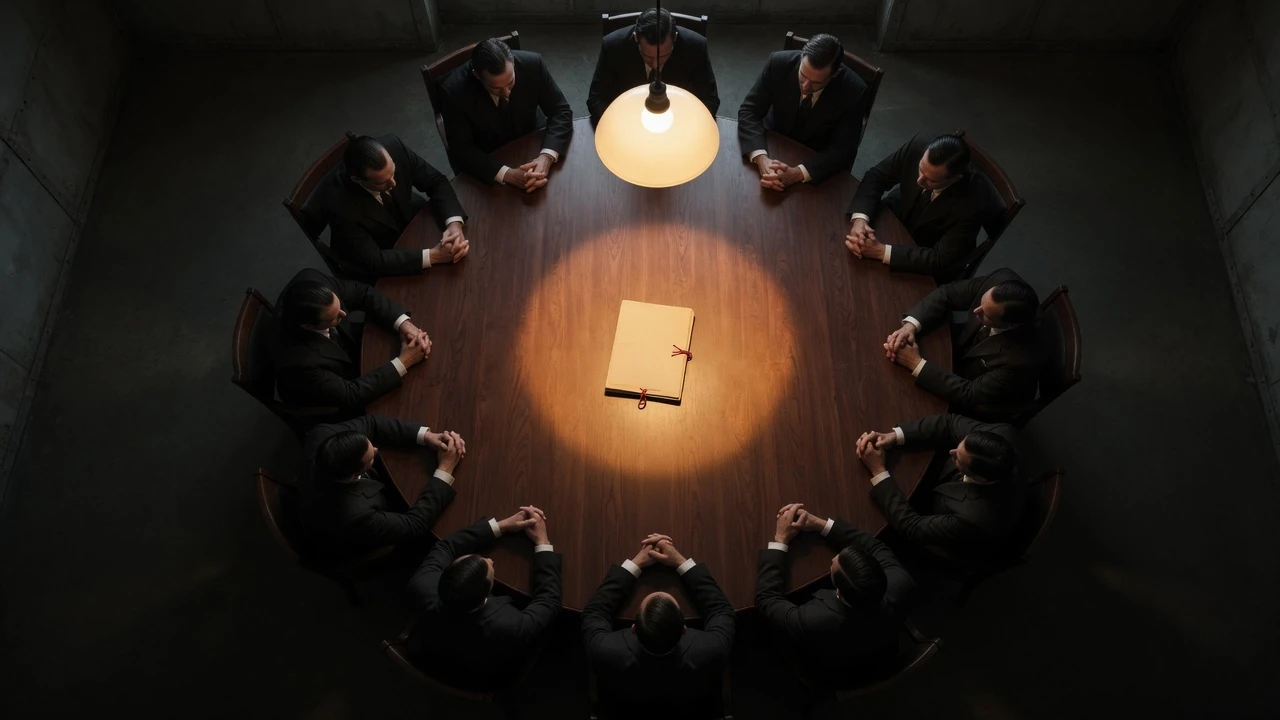
In mid-December 1984, Jaime H. Shandera, a Los Angeles television writer and producer, found a brown package that had been dropped through his mail slot. It had an Albuquerque, New Mexico, postmark and no return address. Inside was a roll of undeveloped 35-millimeter camera film - photographs of documents, not a movie. There was no letter explaining who had sent it or why.
Shandera called William L. Moore, the UFO author he had been working with. They developed the camera film. The frames were photographs of typed pages, not of wreckage or bodies. Printed out, the set became what people still call the Majestic 12 documents, also written MJ-12 or Majic-12: a purported November 18, 1952, "Top Secret / Eyes Only" briefing for president-elect Dwight D. Eisenhower, plus a short September 24, 1947, memo from President Harry S. Truman to his new Secretary of Defense, James V. Forrestal, authorizing an operation that would be called Majestic Twelve.[1]
If the pages were real, they were the first civilian look at a presidential committee created to recover crashed craft, study the bodies, and keep the public from finding out. If they were not real, someone had built a complete American secret history on a roll of camera film and mailed it to the two men most likely to believe it. Moore and Shandera sat on the paper for more than two years. By the time it reached newspapers in 1987, the name MJ-12 was already circulating in UFO circles, and the FBI would soon stamp the later copies "completely bogus."[2]
Who's who
A lot of names show up in this story. Here are the main ones, so it's easier to keep them straight.
- Jaime H. Shandera - Los Angeles TV producer. Received the anonymous camera film in December 1984. Some writeups use Jamie; he published as Jaime.
- Bill Moore - UFO author, co-writer of The Roswell Incident. Helped publicize the papers. Later said he had passed fake documents for Air Force counterintelligence.
- Stanton T. Friedman - nuclear physicist and lecturer who argued some of the papers were genuine.
- Richard Doty - AFOSI special agent at Kirtland Air Force Base. Already using the MJ-12 name in the early 1980s.
- Paul Bennewitz - Albuquerque engineer the Air Force misled with a false alien-invasion story.
- Timothy Good - British UFO writer who published the documents in 1987 and forced the American release.
- Philip J. Klass - Aviation Week editor and skeptic who tore the papers apart in print and on television.
- Harry S. Truman - U.S. president, 1945-1953. The papers say he created the committee. There is no matching order in his files.
What the photographs showed
The long piece on the roll is usually called the Eisenhower Briefing Document. It is dated November 18, 1952, and it pretends to be a briefing written for Eisenhower after he won the election and before he took office. The author on the page is Rear Admiral Roscoe H. Hillenkoetter, the Navy officer who had been the first director of the Central Intelligence Agency, listed here as MJ-1, the head of the twelve.[3]
The briefing walks Eisenhower through a story that starts in the first week of July 1947, on a ranch northwest of Roswell, New Mexico. A "flying disc" has come down. Army Air Forces teams recover the wreckage and, about two miles east of the main site, four small human-like bodies, dead and already broken up by weather and animals. The public is told a weather balloon story after an early "flying disc" press release. The wreckage and the bodies go to Wright Field in Ohio, later Wright-Patterson Air Force Base, for study.
Then the message turns to a second crash. On December 6, 1950, another object comes down near the Texas-Mexico border, around the towns of El Indio and Guerrero. American teams, the paper says, secure the site even though part of it is on the Mexican side. There is no map packet on the roll. An attachment labeled "H" is supposed to have held photographs. It is not on the roll Shandera developed.
The short Truman-Forrestal memo, dated September 24, 1947, is the founding paper. Truman tells Forrestal to proceed "with all due speed and caution," and says the work will be called Operation Majestic Twelve. The briefing names Vannevar Bush - the engineer who ran American wartime science for Roosevelt and then Truman - as the man who recommended the committee. Forrestal is on the list. When Forrestal left office and then died in 1949, later versions of the story put Gordon Gray, a North Carolina lawyer who had been Secretary of the Army, in his chair.
The twelve names on the briefing are a plausible 1947 roster if you were inventing a crash-recovery board: Hillenkoetter; Bush; Forrestal; General Nathan F. Twining, who ran Air Materiel Command and later became Chairman of the Joint Chiefs; General Hoyt S. Vandenberg, Air Force Chief of Staff; Detlev Bronk, a physiologist who headed the National Research Council; Jerome C. Hunsaker, an aeronautical engineer at MIT; Sidney W. Souers, the first Director of Central Intelligence; Gray; Donald H. Menzel, a Harvard astronomer who spent years telling the public flying saucers were misidentifications; Lloyd V. Berkner, a geophysicist who later sat on a CIA scientific panel about UFO reports; and General Robert M. Montague, who commanded the Sandia atomic base in New Mexico. Every one of them was dead by the time the package arrived in 1984. Nobody on the list could be asked, on camera, whether the committee had existed.
The briefing uses a phrase that would stick: extraterrestrial biological entities, EBEs. It treats Projects Sign, Grudge, and Blue Book - the real Air Force UFO offices at Wright-Patterson - as cover layers under MJ-12. It tells Eisenhower the subject is so large that ordinary oversight would cause panic. That is the whole claim in one folder: Roswell was a ship, the bodies were not human, twelve men ran the file, and the President is only now being told.
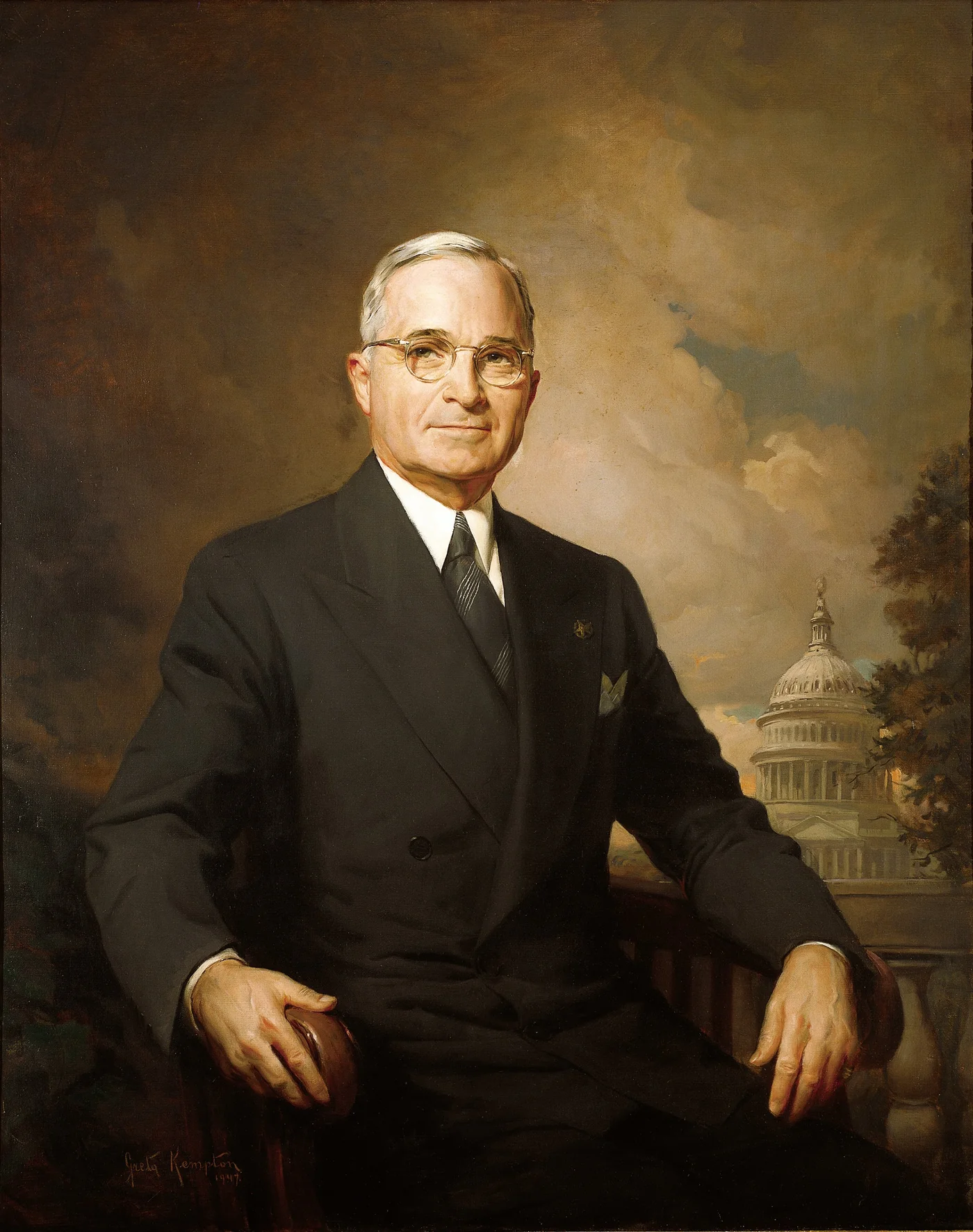
Harry S. Truman, official portrait by Greta Kempton. The MJ-12 papers say he created the committee on September 24, 1947. His presidential library has no matching order. Wikimedia Commons, public domain.
The name was already in circulation
The Albuquerque postmark on Shandera's package is not a small detail. In the early 1980s, Albuquerque was where Air Force counterintelligence at Kirtland Air Force Base had been feeding a false alien story to Paul Bennewitz, an instrument maker who lived on the edge of the base and had been filming lights over the Manzano weapons-storage mountain. Special Agent Richard C. Doty of the Air Force Office of Special Investigations (AFOSI) later said, in public, that his job was to mislead Bennewitz. Moore later said AFOSI recruited him in 1980 to report on Bennewitz and, in exchange, handed him official-looking paper.
One of those pages is the subject of a separate article here: Project Aquarius. On November 17, 1980, a message that looked like AFOSI traffic named a classified UFO program called Aquarius and, in a last paragraph, "MJ Twelve." The real Project Aquarius was an ARPA radar study about ocean surveillance. The alien file on the circulating copy was not. Researchers who later opened Moore's tapes with National Enquirer reporter Bob Pratt found that Moore and Doty were already talking about those names in 1982, two years before the package arrived. Pratt's working title for a book they never published was MAJIK-12. Moore changed it to The Aquarius Project.[1]
So the 1984 photographs did not invent the committee. They gave a name Moore and Doty were already talking about a 1947 birthday, a membership list, and a Roswell origin story. That is why the Albuquerque postmark still bothers people who think the papers were a civilian hoax cooked up in Los Angeles. It is also why people who think the papers were Air Force disinformation point at Kirtland first.
A memo in the National Archives
Moore, Shandera, and Stanton T. Friedman - a nuclear physicist who had left reactor work in 1970 to lecture full time on flying saucers, and who had been the civilian who put the Roswell crash back into print - did not take the photographs public in 1984. They shared them with a small circle and went looking for anything in real archives that mentioned MJ-12.
In 1985, following a string of anonymous postcards that pointed them toward a particular box, Moore and Shandera said they found a one-page memo in Record Group 341 at the National Archives in Washington. It is dated July 14, 1954. It is from Robert Cutler, special assistant to President Eisenhower, to General Twining. The subject line reads "NSC/MJ-12 Special Studies Project." The body is short. It postpones a briefing scheduled for July 16. It does not say what MJ-12 is.[5]
Archivists have spent forty years answering mail about that page. Their reference report is unusually blunt. Searches of Air Force records, Joint Chiefs records, and the Truman and Eisenhower libraries for "MJ-12," "majestic," "unidentified flying objects," "UFO," "flying saucers," "extraterrestrial biological entities," and "Aquarius" came back empty except for this one memo. The memo sits in a Top Secret register series but does not carry a Top Secret control number. It sits in a folder whose other papers do not match it. Cutler, the man whose name is on it, was out of the country on the date he supposedly wrote it. Philip J. Klass, an Aviation Week & Space Technology editor who had been taking UFO claims apart since the 1960s, published that travel fact in Skeptical Inquirer and treated the memo as a plant meant to make the 1984 photographs look older than they was.[6]
The papers go public
In 1986 an anonymous source offered the documents to British researcher Jenny Randles. She declined. In 1987 another copy reached Timothy Good, a British UFO writer finishing Above Top Secret: The Worldwide UFO Cover-Up. Good put the papers in the book. On May 31, 1987, American wire stories ran the claim that 1950s-era UFO documents had surfaced. Moore, Shandera, and Friedman, who had been sitting on their own copy, went public that same spring, including a June presentation at a MUFON symposium. The London papers had forced their hand.[7]
By then the story was no longer a private authentication project. The New York Times and the Washington Post carried it. On June 24, 1987 - the fortieth anniversary of Kenneth Arnold's 1947 sighting of nine objects near Mount Rainier, the report that put "flying saucer" into American English - ABC Nightline sat Friedman across from Klass, with Ted Koppel in the middle. Friedman argued the papers matched real people and real secrecy habits. Klass argued they were a hoax with sloppy typewriter work. Spokesmen for the White House and the National Security Council said that summer that no organization called Majestic-12, MJ-12, or Majic-12 existed.[1][8]
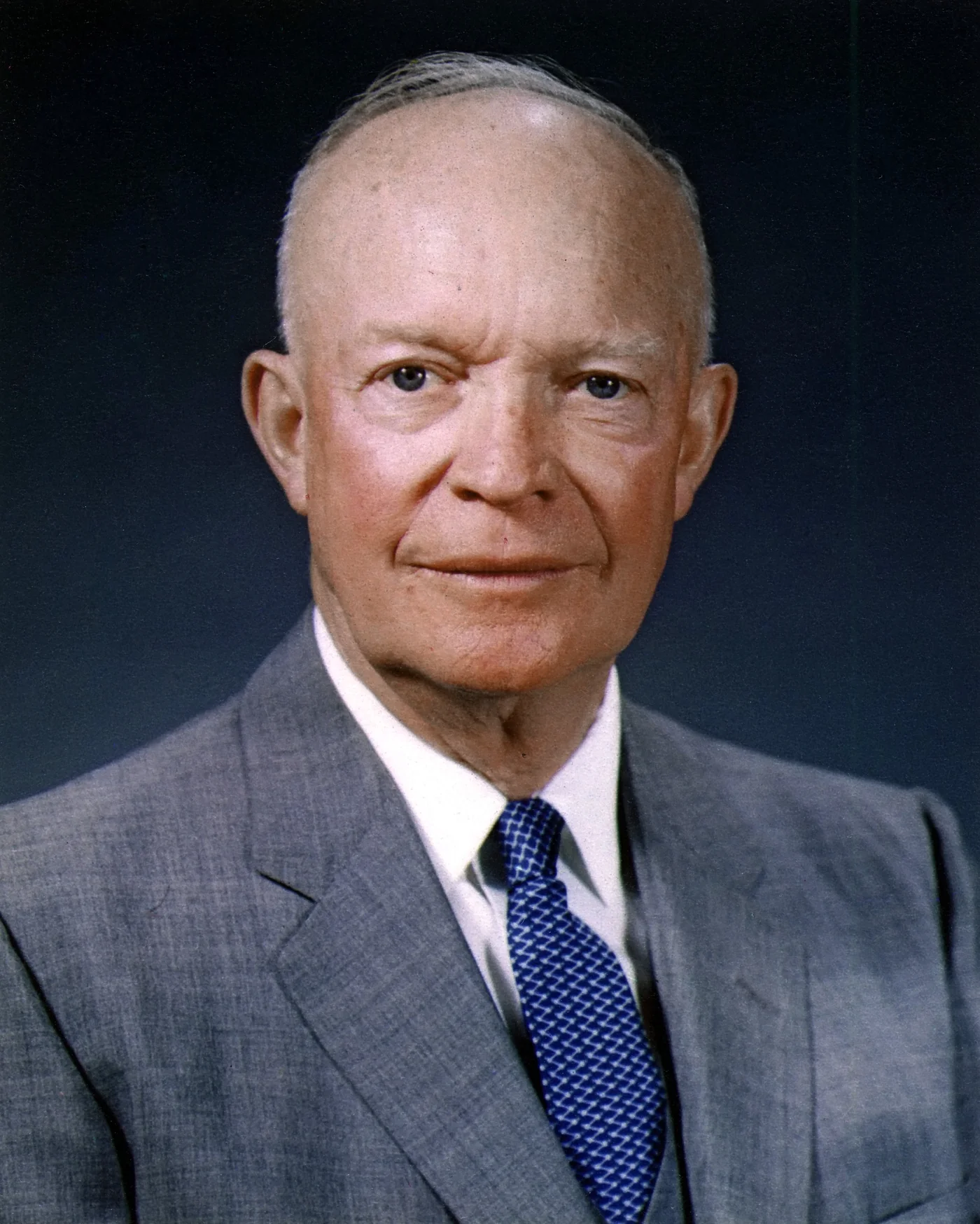
Dwight D. Eisenhower, official portrait, May 29, 1959. The long paper on Shandera's roll is written as a briefing for him as president-elect in November 1952. White House / Wikimedia Commons, public domain.
Video: Stanton T. Friedman, "UFOs and MJ-12," live lecture. Friedman is the nuclear physicist who sat with Moore and Shandera on the 1984 photographs and spent years arguing the papers were genuine.[4]
A live show and a Nevada test site
On October 14, 1988, a syndicated two-hour special called UFO Cover-Up? Live!, hosted by actor Mike Farrell, put the committee in front of a much larger audience than any MUFON hall. Two men appeared in shadow under the code names Falcon and Condor. They talked about a secret agreement with small gray visitors and about a Nevada test site, Area 51, as a place where the government kept alien craft. For many viewers that night was the first time they heard Groom Lake talked about in connection with recovered bodies instead of spy planes. Later reporting has treated Falcon as Doty, or as a composite built around him. Condor's identity is still argued. The show is not evidence that the 1947 committee existed. It is evidence of how fast the 1984 photographs, the Kirtland campaign, and a live television format could put those names on the same broadcast.[9]
Video: the Falcon and Condor segment from UFO Cover-Up? Live! (1988). Two unnamed "government informants" describe aliens, a treaty, and a Nevada base.[11]
The FBI file
In 1988 the papers stopped being a UFO-conference problem and became a Bureau problem. On September 15, an AFOSI special agent in Dallas called the FBI after someone at a school mailed in a copy of the Majestic 12 memo and presented it as a leaked classified document. The Dallas office opened a file. The question on paper was whether someone had committed a federal offense by circulating what looked like a Top Secret presidential briefing.
The Bureau sent the pages to AFOSI for a look. On November 30, 1988, AFOSI answered that no such committee had ever been authorized or formed, and that the document was fabricated. The FBI's own write-up is the line that still gets quoted: the document is "completely bogus." Copies, the file says, had been mailed around the country. The Director told Dallas to close the case.[2]
What the file does not contain is almost as useful as what it does. There is no hunt for a forger. There is no interview with Moore or Shandera. There is no ink or paper analysis of an original, because nobody ever produced an original - only photographs of pages, then photocopies of those photographs. Emma Best, writing for MuckRock after the Vault release, called it one of the Bureau's lazier "X-Files" investigations: they had statutes they could have used if they thought someone had forged a government document, and they used none of them once AFOSI said the committee was not real.[12] The marked pages are in the FBI Vault file and on the Project Aquarius article.
Why the pages don't look like 1947
Klass's published work, and later pieces in Skeptical Inquirer by Joe Nickell and others, did the kind of document work the FBI file skipped. The Truman signature on the September 24, 1947, memo matches, scratch marks included, a genuine signature Truman put on a real memo to Vannevar Bush on October 1, 1947. The implication is simple: someone photocopied a real autograph and pasted it onto a new text. A 1947 original would not carry the accidents of a later letter.[13]
The date style on the briefing - a zero in the day, a particular way of writing the month - matched a format Moore used in his own letters. Klass also reported a conversation, later written up by researcher Brad Sparks, in which Moore talked about creating fake Top Secret papers in hopes that real insiders would come forward to correct them. That's not a confession that Moore typed the Eisenhower briefing, but it's a record that the man who first sat with the photographs had already discussed planting hoax documents as a research tactic.
Language on the pages has bothered archivists too. Words and senses that were rare in 1952 executive prose show up as if they were ordinary. The surviving items are photocopies of photographs. There is no ribbon, no paper stock, no ink to date. Friedman spent years answering those points in lectures and in Top Secret/Majic (1996). He said some typefaces and security markings did match period files, that Menzel's public skepticism made him a useful member if the committee wanted a scientist who could dismiss saucers in print, and that the absence of a paper trail is what a real Special Access program would look like. He did not produce an original. Nobody from the alleged 1947 roster ever confirmed the committee on the record.
Moore confesses at MUFON
On July 1, 1989, at the MUFON symposium in Las Vegas, Moore gave a lecture titled "UFOs and the U.S. Government." He told the room he had been cooperating with AFOSI since 1980. He said he had passed sanitized and altered papers to Bennewitz, and that he had reported back on how Bennewitz and other researchers were taking the material. He described disinformation the way a counterintelligence officer would: you drop a story on a mark so the mark will repeat it as if it were his own. Then you can leave. The audience treated him as a traitor. He left the conference circuit soon after. The full recording is on the Paul Bennewitz article.[14]
Moore did not stand at the podium and say, "I typed the Eisenhower briefing." He did say he believed the MJ-12 papers themselves were part of the same kind of operation - false documents created to pull UFO researchers toward aliens and away from whatever the Air Force did not want photographed around southwestern bases. That is a different claim from "a civilian hoaxer did it for attention," and it is a different claim from "the 1947 committee was real." It is the claim that sits in the middle, and it is the one Moore was in a position to make, because he had already admitted to passing fake paper.
More paper, then the government looks again
The 1984 photographs were not the last MJ-12 product. In 1994 a purported April 1954 field manual, SOM1-01, the Majestic-12 Group Special Operations Manual, began circulating among researchers. It reads like a how-to for crash retrieval: secure the site, handle bodies, write the cover story. Historians of the documents treat it as a continuation of the same myth, with the same problems - no original, no archival twin, language that does not sit easily in 1954.
That same year, New Mexico congressman Steven H. Schiff asked the General Accounting Office, now the Government Accountability Office, to look for records of the 1947 Roswell recovery and of any Truman-era UFO committee. The Air Force answered with The Roswell Report: Fact vs. Fiction in the New Mexico Desert, which identified the ranch debris as Project Mogul, a classified balloon train built to listen for Soviet nuclear tests. In a 1995 follow-up on the Majestic 12 papers themselves, GAO wrote that the Information Security Oversight Office, the Air Force, and the National Archives knew the material only from copies submitted by members of the public. Archivists found nothing that fit the description of an executive-branch original. The Air Force added that a 1980 message containing the words "MJ Twelve" - the Aquarius teletype - was a forgery.[15]
In 1997, CIA historian Gerald K. Haines published "CIA's Role in the Study of UFOs, 1947-90" in Studies in Intelligence. The article is mostly about U-2 flights being reported as saucers and about the Agency's habit of hiding its own interest. Near the end Haines writes that a series of documents had surfaced around 1984 claiming Truman created Majestic-12 to recover wreckage and bodies, and that "most if not all of these documents have proved to be fabrications." The controversy, he added, persists anyway.[16]
Friedman did not treat those closings as the end of the argument. Top Secret/Majic is still the book to read if you want the case for authenticity from the physicist who sat with Moore and Shandera. He died in 2019, at Toronto Pearson Airport, on his way home from a lecture. His files went to the Provincial Archives of New Brunswick. The originals of the 1984 camera film still have not appeared in any of those boxes as a 1947 government ribbon copy, because they were never that.
Video: UFO Cover-Up? Live! (1988), remastered upload. The full syndicated special that put MJ-12, Falcon and Condor, and Area 51 on the same night of television.[10]
The name in a video game
By 2000 the committee had left the archive argument and become a stock villain in fiction. Deus Ex, the Ion Storm role-playing game released that year, uses Majestic 12 as the main hidden power. In the game's story the group starts as an arm of the Illuminati and then splits off under a billionaire named Bob Page. It runs a national security agency from the inside, keeps a base at Area 51, and tries to control the world through communications, nanotechnology, and a plague called the Gray Death. The in-game motto is Ipsa scientia potestas est - knowledge itself is power. Later sequels keep the name.
What is still sitting on the table
You can tell this story as a hoax, as a counterintelligence job, or as a leak of a real 1947 committee. The first two have documents you can hold. The third still does not.
The hoax version is the one Klass wrote and the one AFOSI gave the FBI. Someone who knew UFO literature, knew the 1947 cast list, and had access to a photocopier built a briefing, mailed it to Shandera, and later planted or encouraged the Cutler memo so the photographs would have an archive cousin. Moore's own talk about fake Top Secret papers, the date format, and the pasted Truman signature all sit comfortably here.
The counterintelligence version is the one Moore offered in 1989 and the one Brian Dunning walks through on Skeptoid. AFOSI already had a reason to feed alien stories to people watching Kirtland and other southwestern ranges. They had already used Aquarius and MJ Twelve on paper aimed at Bennewitz. Mailing a richer version of the same story to Moore's partner, with an Albuquerque postmark, would be a continuation of that work, not a new hobby. The FBI's decision not to look for a forger fits a world in which the Air Force did not want a civilian trial about who typed the extra lines.
Video: Brian Dunning, Skeptoid #528 - "The Secret History of Majestic 12." A short walk through the paper trail, including Moore's later suspicion that the documents were Air Force disinformation rather than a civilian hoax.[7]
The leak version is the one Friedman kept. A real committee would leave almost no file. The names are the right names. Hillenkoetter later sat on the board of NICAP, a civilian UFO group, and said some objects were intelligently controlled. That is a real later fact about a real admiral. It is not a 1947 membership roster. It does not make the September 24 memo a presidential order.
What nobody has found is the thing that would settle it: a 1947 original in a presidential library, someone from the alleged roster on the record, or a forger in a courtroom. The National Archives still answers letters about one Cutler page that does not identify the project. The FBI Vault still hosts a closed file stamped bogus. The name still restarts every time a new UAP hearing makes the news, because the 1984 photographs gave American UFO lore a committee, a crash, and a list of twelve men. That is a lot of work for a roll of camera film that came through a mail slot with no return address.
Video: The Why Files, "Majestic 12 | Secret Documents Expose UFO Cover-Up Vol. 1." A long modern recap of the papers and the people around them. Watch it after the chronology above, not instead of it.[17]
Sources
- Grokipedia. "Majestic 12." Timeline of the 1984 camera-film leak, the 1987 public release, the Pratt novel title, Klass's forensic points, and the FBI close. grokipedia.com/page/Majestic_12
- Federal Bureau of Investigation. The Vault: Majestic 12. The 1988 Dallas submission, AFOSI's finding that no such committee was formed, and the "completely bogus" close. vault.fbi.gov
- Grokipedia. "Majestic 12." First-timer map of the alleged committee, the Eisenhower briefing, and the later official denials. Richard C. Doty has no solo encyclopedia page; Wikipedia's Richard Doty / Richard L. Doty page is a University of Pennsylvania smell researcher, a different person. Doty in this story is covered on the Paul Bennewitz page. grokipedia.com/page/Majestic_12
- Friedman, Stanton T. "UFOs and MJ-12." Live lecture. The case for the papers from the physicist who sat with Moore and Shandera. youtube.com/watch?v=yJl0NXJUyTc
- National Archives. "Project BLUE BOOK - Unidentified Flying Objects," including the Majestic 12 reference report on the Cutler-Twining memo and the negative NSC index searches. archives.gov
- Klass, Philip J. "The MJ-12 Crashed-Saucer Documents." Skeptical Inquirer 12, no. 2 (Winter 1987-88). Cutler out of the country, the pasted Truman signature, and the date-format argument. skepticalinquirer.org
- Dunning, Brian. "The Secret History of Majestic 12." Skeptoid #528, 19 July 2016. Transcript and audio. skeptoid.com/episodes/528 Video: youtube.com/watch?v=Tv8Jcpc5rA0
- ABC Nightline. Stanton Friedman and Philip J. Klass, 24 June 1987. Posted by Eyes On Cinema. The embed of this broadcast is on the Project Aquarius article. youtube.com/watch?v=AW6xj9xCs_8
- IMDb. UFO Cover-Up?: Live! (1988). The 14 October syndicated special. There is no standalone encyclopedia page for the broadcast. imdb.com/title/tt0846738
- UFO Cover-Up? Live! (1988), remastered upload. youtube.com/watch?v=JTlGLIbv31w
- Falcon and Condor segment from UFO Cover-Up? Live! (1988). youtube.com/watch?v=iUgTDXZAElw
- North-Best, Emma. "Conspiracy Weary: FBI's real-life 'X-Files' document one of the Bureau's laziest investigations." MuckRock, 5 June 2017. muckrock.com
- Klass, Philip J. "The New Bogus Majestic-12 Documents." Skeptical Inquirer, May/June 2000. Later document set and the continued signature problem. skepticalinquirer.org
- Moore, William L. "UFOs and the U.S. Government." MUFON symposium lecture, 1 July 1989. The complete recording is on the Paul Bennewitz article. Paul Bennewitz: UFO disinformation
- U.S. General Accounting Office. "Comments on Majestic 12 Material," 1995. Agencies knew the papers only from public submissions; the 1980 "MJ Twelve" message was a forgery. gao.gov/products/154832
- Haines, Gerald K. "CIA's Role in the Study of UFOs, 1947-90." Studies in Intelligence, 1997. Official CIA historical review; MJ-12 documents treated as fabrications. cia.gov PDF HTML reprint: sgp.fas.org
- The Why Files. "Majestic 12 | Secret Documents Expose UFO Cover-Up Vol. 1." youtube.com/watch?v=s9VoC8MoeUs
- Friedman, Stanton T. Top Secret/Majic: Operation Majestic-12 and the United States Government's UFO Cover-up. Marlowe, 1996. The case for authenticity from the physicist who sat with Moore and Shandera. amazon.com
- Good, Timothy. Above Top Secret: The Worldwide UFO Cover-Up. William Morrow, 1988. The book that put the documents in front of the press in 1987. amazon.com
- Bishop, Greg. Project Beta: The Story of Paul Bennewitz, National Security, and the Creation of a Modern UFO Myth. Paraview Pocket Books, 2005. The Kirtland campaign the MJ-12 name came out of. amazon.com
- Pilkington, Mark. Mirage Men: An Adventure into Paranoia, Espionage, Psychological Warfare, and UFOs. Skyhorse, 2010. Book on Amazon. Film: Lundberg, Denning, Kyprianou, dirs. Mirage Men (2013). Watch on Amazon
- Grokipedia. "Deus Ex." The 2000 game that turned MJ-12 into a playable conspiracy, including the split from the Illuminati and the Area 51 base. grokipedia.com/page/Deus_Ex
- Grokipedia. "Stanton T. Friedman" and "Philip J. Klass." Biographies of the two men on the 1987 Nightline set. Friedman · Klass
- Grokipedia. "Roswell incident" and "Project Mogul." What the 1994 Air Force report put in place of the briefing's crash story. Roswell · Mogul
- Mutual UFO Network (MUFON). Official site of the civilian group that hosted Moore's 1989 speech and the 1987 public presentation. mufon.com
- Federal Bureau of Investigation. Crop of the alleged Majestic 12 memo as received in 1988. Wikimedia Commons, public domain
Further reading
← Back to 🛸 UAPs/UFOs
Related:
Project Aquarius ·
Paul Bennewitz ·
Project Stargate