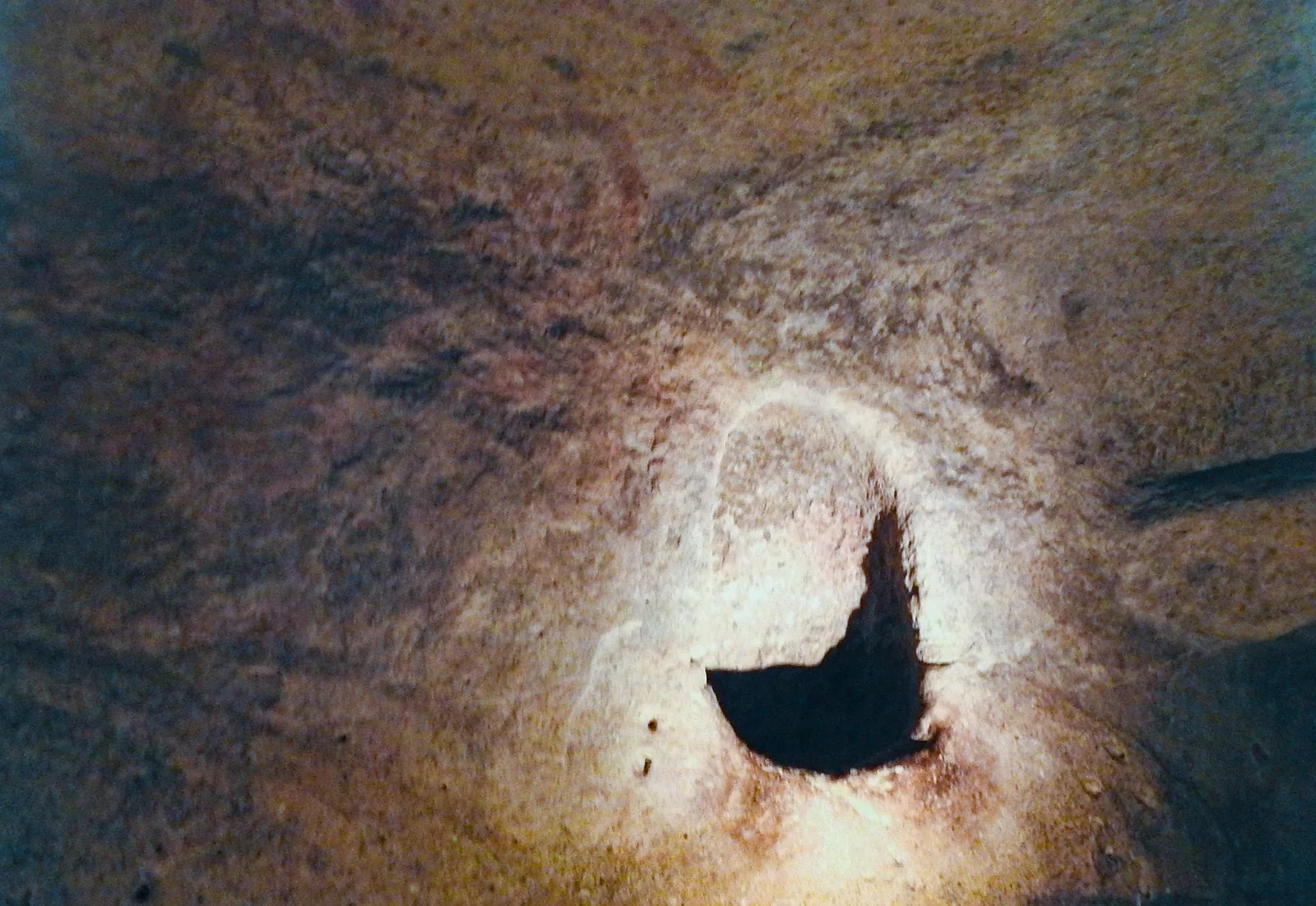
In 1902, a stone mason cutting cisterns for new houses in Paola - a town on a hill above the inner Grand Harbour of Valletta, Malta - broke through a roof that led to an underground labyrinth. It was cut from globigerina limestone, the island's soft yellow building stone. People call it the Ħal Saflieni Hypogeum (roughly "hal saf-LYEH-nee"). Hypogeum is just Greek for underground.[1]
Over centuries, from about 4000 BC to 2500 BC, people dug three stacked levels with antler, flint, chert, and obsidian, down to about 10.6 meters below today's street. Some rooms copy the interiors of Malta's above-ground megalithic temples: fake doorways, corbelled ceilings that step inward like a stone roof, painted red spirals. UNESCO listed it in 1980 as the only known European subterranean labyrinth of that age. One small side room on the middle level is what later writers named the Oracle Chamber or Oracle Room. Speak into a niche in the wall - a small recess cut into the stone - and the voice comes back bigger, lower, and farther than it should.[2]
The claim around that niche is that the people who cut the Hypogeum tuned the room on purpose, so chanting or drumming would carry through the burial complex and change how a listener felt.
Magri dies and the notes vanish
Excavation started in November 1903 under Manuel Magri (also written Emmanuel), a Maltese Jesuit priest and ethnographer working for the Museums Committee. He directed the dig until 1907, then died suddenly in Tunisia on missionary work. Any field notes he had taken were lost, so the man who opened the Hypogeum didn't leave a usable report of those first years.[3]
Themistocles "Temi" Zammit took over - a Maltese doctor, chemist, and archaeologist who became Malta's main prehistorian. He dug from 1907 to 1911 and published a first report in 1910. The floors were earth mixed with human bone and animal bone. Bodies hadn't been laid out one by one. They look as if flesh was allowed to go first, then the remaining bones were gathered, stained with red ochre, and piled. Zammit later wrote that low notes spoken or sung near the niche resounded and vibrated, and that voices were magnified and carried through the space.[4]
He also gave the number people still quote: the bones of some 6,000 to 7,000 people were found. From one sample patch three meters long, one meter wide, and one meter deep, Zammit salvaged 119 right kneecaps, so at least about 120 people in that patch alone. He then scaled up from the area of the caves, the depth of the red soil, and how the bones were packed, and came to an estimate of about 7,000 individuals.[5]
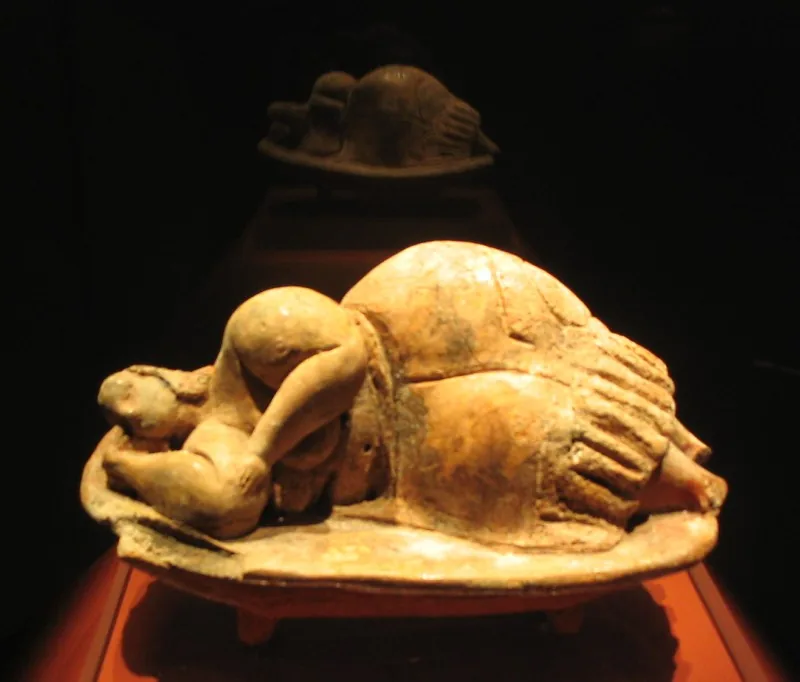
The Sleeping Lady, a clay figurine found in the Hypogeum, now at the National Museum of Archaeology in Valletta. Photo: Stefan h, Wikimedia Commons (public domain).
Among the pottery, shell buttons, and small carved animals was a clay woman lying on her side on a couch, about twelve centimeters long, with traces of red ochre. She's the Sleeping Lady. She didn't come from the Oracle Chamber. She came from a pit in the complex, and she now sits in the National Museum of Archaeology in Valletta, because Heritage Malta, the national agency that runs the monument, didn't want to keep her underground.
Griffiths writes an article for National Geographic
In May 1920, William Arthur Griffiths wrote the first widely read account of the echo for National Geographic, in a piece titled inside the magazine "Malta: The Halting Place of Nations." He had been told, he wrote, that only a few months earlier someone noticed that any word spoken into the Oracle Room "was magnified a hundred-fold and audible throughout the entire underground structure." A curved projection carved at the back of the chamber, he said, acted as a sounding-board. He imagined what that would have done to a believer when "the oracle spoke and the words came thundering forth through the dark and mysterious places with terrifying impressiveness."[6]
"A hundred-fold" is a magazine sentence, not a measurement. Later work would show he was right about the direction - sound made in that room does get louder farther away, which is the opposite of what happens in open air - and wrong if you take the number as a lab result. Still, by 1920 this was already the room people pointed to when they wanted to say the Hypogeum was more than a cemetery.
Later archaeologists kept hearing the same thing in plainer language. J. D. Evans, who surveyed Maltese prehistory in 1971, wrote that a deep echoing sound can be set up by speaking into the niche. David Trump, another British archaeologist of the temples, wrote of a projecting ridge on the end wall that "might have been specially made to carry the sound," and of a powerful reverberation to a deep voice.
A public documentary covers the 1902 find, the three levels, and the Oracle Room's reputation before anyone put a microphone in:
Video: Geographics - Hypogeum: Malta's Ancient Subterranean Mystery. Oracle Room acoustics start around 8:05.[15]
Three levels and a small painted room
The Hypogeum covers about 500 square meters on three levels. The upper level is the oldest, scooped from the brow of the hill, and was probably open to the sky at first, with a now-lost building at the entrance. The middle level is the finished one: smooth walls, painted ceilings, the so-called Holy of Holies with its carved temple façade, and the Oracle Chamber off to one side. The lowest level is darker, wetter, and harder to visit. Heritage Malta - the agency that runs the site - lets about ten people in at a time, because carbon dioxide, temperature, and humidity all move when bodies stand in the rooms, and because the painted plaster can't take flash or crowds. Photography isn't allowed on site. Heritage Malta's own short film is the agency's look at the rooms:[1]
Video: Heritage Malta - official Hypogeum clip from the agency that runs the site.[16]
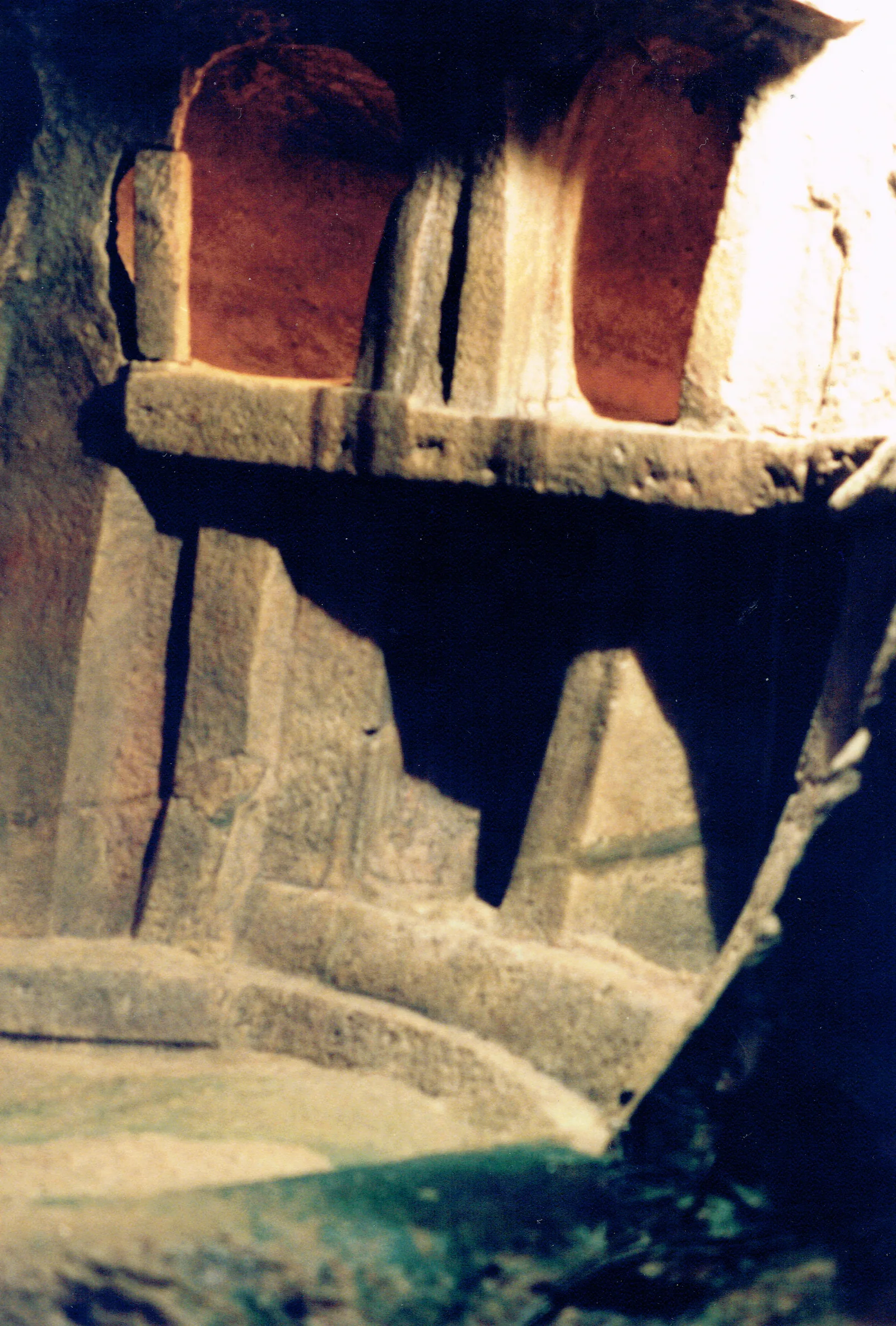
The Holy of Holies, middle level: a chamber cut to look like the inside of an above-ground Maltese temple. Photo: Wikimedia Commons.
The Oracle Chamber itself is one of the smaller side rooms, roughly rectangular, with an elongated inner space and a ceiling painted in red ochre - spirals, disks, honeycomb. These are the only prehistoric wall paintings known on the Maltese islands. Near the entrance is a niche. Farther in is a second niche with three painted red disks on its inner surface. The painted spirals and disks get larger as they approach that second niche and stop just before it. Paul Devereux, a British researcher who helped start modern archaeoacoustics - the study of sound at ancient sites - argued in 2009 that the niche worked like a speaking tube, and that the growing spirals and disks could be a picture of amplitude, the way the sound gets bigger at that spot.[7]
That's Devereux interpreting the paint, not measuring the sound. What nobody who has stood there disputes is the niche itself. UNESCO's official text puts it this way: "In one of these decorated chambers, there is a small niche which echoes when someone speaks into it. While this effect may not have been created intentionally, it may well have been exploited as part of the rituals that took place within the chambers."[2] That's the argument: the echo is there, but we don't have a way to prove they cut it on purpose.
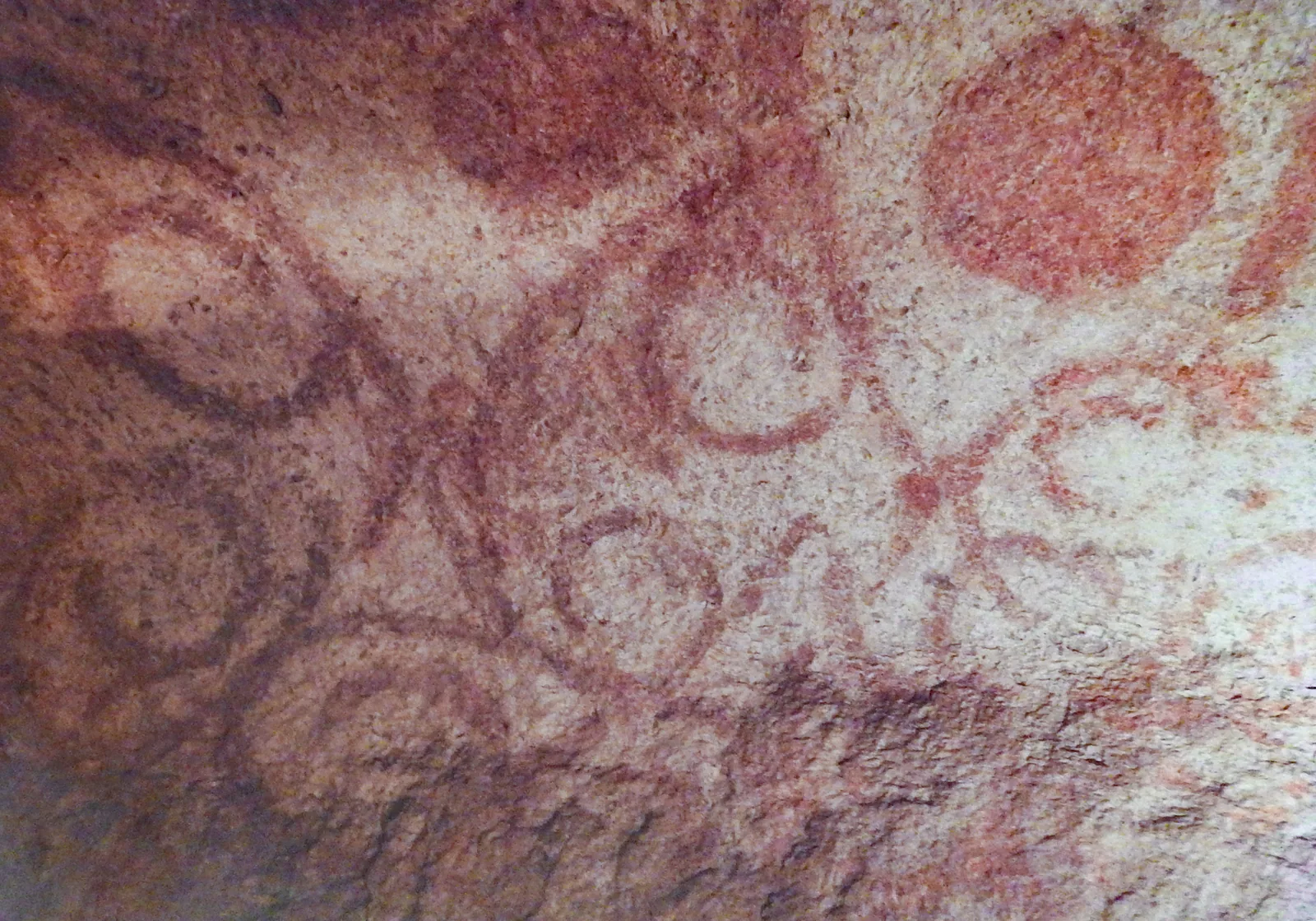
Red ochre spirals and disks on the Oracle Chamber ceiling. Photo: Xiquinho Silva, Wikimedia Commons (CC BY 2.0).
Why they expected 110 hertz
The number most web write-ups attach to the Hypogeum is 110 Hz - 110 cycles per second - sometimes written as 111. It didn't start in Malta. In the mid-1990s, Paul Devereux - the British researcher who later wrote about the painted niche - and the physicist Robert Jahn measured resonances in several British and Irish Neolithic chambers, including Newgrange in Ireland, a passage tomb built around 3200 BC, and found a cluster between about 95 and 120 Hz, often near 110-112. That band sits in the human singing range. Popular write-ups later treated 110 Hz as the Oracle Chamber's own note.
In 2008, Ian A. Cook, Sarah K. Pajot, and Andrew F. Leuchter at UCLA ran a small EEG study that is now often cited as evidence that this pitch changes brain state. Thirty healthy adults, mean age 78.6, sat with eyes closed and listened through speakers to one-minute tones at 90, 100, 110, 120, and 130 Hz. At 110 Hz, activity in the left temporal region - language territory - was lower than at neighboring tones, and prefrontal activity flipped toward the right side. The authors called it a pilot and said the interpretation was open. They were in a UCLA lab, not in Malta and not in any tomb.[9]
That's the number the 2014 teams expected to find in the Oracle Chamber.
They bring microphones in 2014
In February 2014, the OTS Foundation - the Old Temples Study Foundation, a group based in Malta and Florida and run by Linda Eneix - hosted an archaeoacoustics conference on the island. Heritage Malta gave a research team a few hours in the Oracle Chamber on 21 February 2014. Lights stayed low to protect the paintings. The Hypogeum sits under houses in Paola, so they first recorded the background: a little neighborhood noise, nothing loud.
Paolo Debertolis, then at the University of Trieste, ran the SB Research Group, an archaeoacoustics team. He came with Fernando Coimbra of the University of Coimbra in Portugal, and with Eneix. They set Tascam recorders and Sennheiser microphones on tripods in the middle of the Oracle Chamber, inside the visitor railing, and put another recorder outside the door to hear what leaked. They stood near the first niche on the left of the entrance, which they treated as the best place to start a resonance - the frequency at which a space rings instead of just echoing. Iegor Reznikoff, a French researcher who has spent decades singing in painted caves to map their acoustics, used his voice. They also tested a female shout, a Mediterranean trumpet shell (Charonia lampas, the Maltese bronja), a bull horn with a reed mouthpiece, a Maltese friction drum, and a goat-skin frame drum. The instruments came with advice from Anna Borg Cardona, a Maltese musicologist. Fragments of Charonia shells have been found on prehistoric sites on the islands, so the shell wasn't a random prop.[7]
Here's what they reported. A male voice singing a long "ooh" at the right pitch stimulated the room at about 114 Hz and also at 68-70 Hz. 114 Hz sits near A2 on a modern piano, in a bass or baritone range. A weak voice at the right frequency did more than a shout at the wrong one. Shouting, male or female, peaked around 900 Hz and didn't ring the structure. The conch peaked around 290 Hz and didn't ring it either. The bull horn didn't show up as a resonance on the graphs, though Coimbra wrote that he felt the sound cross his body while standing in front of the paintings in another room. The friction drum, tuned near 109 Hz, partly stimulated the 114 Hz resonance. The frame drum, hit hard, produced harmonics that looked a lot like the male "ooh": a strong room response at 114 Hz and a smaller one around 70 Hz. A soft hand on the same drum did much less.
They also wrote that some sounds hung on for seven or eight seconds after the source stopped. Glenn Kreisberg, a radio-frequency engineer on the visit, looked at the ceiling near the entrance and the long inner chamber and said the cut looked like a waveguide - a shape that steers long, low sound waves. Debertolis, Coimbra, and Eneix published the work in 2015 in the Journal of Anthropology and Archaeology. Their conclusion was that a male voice chanting, or a drum at the right pitch, could drive the room, and that a woman with a drum could get the same effect. They couldn't rebuild the rituals, they said, but it was naïve to think Neolithic people failed to notice the sound, or failed to use it.
Till measures the same afternoon
The same day, after Debertolis finished, Rupert Till, a music archaeologist at the University of Huddersfield, ran a different test in the same chamber. He didn't use a singer. He played a sine sweep, a tone that glides from 20 Hz to 20,000 Hz, through a small B&O Beolit loudspeaker that had already been measured in an anechoic chamber, a room built to have no echo of its own. Two DPA 4006 microphones caught the result. Software then pulled out the room's impulse response: a record of how that speaker position and that microphone position behaved. He put the speaker about half a meter, one meter, and two meters from the niche, and also at the chamber entrance about six meters away. Microphones sat inside the Oracle Chamber and out in the main hall, as far as about fifteen meters from the niche.[4]
Till was polite about the morning's work and also blunt. Voice and folk instruments aren't a repeatable source. You can't rerun "Reznikoff sings ooh" the way you can rerun a sweep. What Debertolis had shown, Till said, was that some frequencies ring longer than others, that the reverb is long, and that different sources behave differently. His own paper came out in Antiquity in 2017.
With the speaker two meters from the niche, sound was louder at the far microphone than at the near one. In open air you'd expect a drop of maybe 12 decibels over ten meters. Inside the Hypogeum the level went up. Griffiths was right that the sound gets bigger, even if "a hundred-fold" was magazine talk. Speech, though, was a mess. A standard score for lost consonants put almost every listening position in "worthless intelligibility" unless you were standing right next to the speaker. A voice from the Oracle Chamber would be heard through the complex, but you wouldn't understand the words. Till's point was that singing, chanting, or drumming would use the room better than talking.
He also pushed back on the idea that only male voices work. A speech-transmission score for a typical female voice and a typical male voice differed by less than the just-noticeable amount. Low frequencies behave one way and high frequencies another, whether the person is a man or a woman. A low voice will boom, and a higher, clearer voice will articulate better. Earlier writers who tested only deep male voices had, he suggested, mostly measured the voices they chose to test.
Bass ratio - how much the low end outlasts the rest - was extreme. Inside the Oracle Chamber it sat around 4 to 6, where a concert hall wants something near 1. With a microphone out in the main hall it jumped into the teens. Reverberation time at 63 Hz reached about 8 seconds inside the chamber and more than 13 seconds in the hall, and Till reported tails up to about 16 seconds at low frequencies. That's longer than the stone circles, cathedrals, and painted caves he had measured. The strongest resonances he plotted in the Oracle Chamber were around 72 and 75 Hz, with others at 134, 161, 186, and 196 Hz. Out in the main hall, with the source still in the Oracle Chamber, a 41 Hz peak dominated - below a singing voice, more like a large drum, grinding stone, wind, or thunder. The Main Hall itself looked as if it had a lower, stronger resonance than the Oracle Chamber. The niche made some effects stronger, but not in a clean, always-louder way. Standing next to other walls can do similar things, because hard surfaces make standing waves.
Till didn't claim to have proved that anyone designed the room as an instrument. He said the opposite up front: the study wasn't built to prove intent, or a specific voice, or a specific instrument. What he would say for sure was that the people who made the Hypogeum lived in an oral culture, that the acoustics aren't subtle, and that the sound "must have had particular significance and ritual power." He also listed how the modern visit differs from the original rooms. Magri's notes are gone. The bones and soil that once filled the floors are gone, and those would have soaked up some of the boom. A metal walkway sits on the floor, the old open upper level is now inside a visitor center, and houses sit on top. Water drips, and traffic leaks in. The room you hear in 2014 isn't the room of 2500 BC, even if the rock is the same rock.
A walkthrough of the Hypogeum and the Oracle Chamber:
Video: Ancient Architects walks the Hypogeum and the Oracle Chamber. Watch on YouTube if the embed doesn't start.[8]
Tuned on purpose, or just used
The strong version of the story is that Neolithic builders carved the Oracle Chamber as a tuned room: niches as speaking tubes, a waveguide ceiling, paint that Devereux read as a picture of growing sound, and a priest or singer whose voice would boom through a complex full of the dead and put listeners into an altered state. That version uses real features - the niches are cut, the paint is there, the ridge is there, the smoothness of the middle level is different from the rough upper level - and treats them as proof of a plan. We don't have that proof. There's no inscription, no surviving instrument found in the niche, and no way to watch a ritual.
Once you measure it, the Oracle Chamber isn't a single note at 110 Hz. Debertolis got 70 and 114 from a voice and a drum. Till got 72-75 in the chamber and 41 out in the hall. Those are related numbers, not the same number, and none of them prove the builders aimed at one exact pitch. Eneix, who helped get the 2014 teams into the Hypogeum, warned that a lab tone isn't the same as standing in the chamber with the air moving around your body.[10]
The simpler claim is that they didn't have to tune the room on purpose to notice the sound and use it. The people who used Ħal Saflieni spent centuries cutting rooms that weren't the simplest pits they could have dug. They copied temple architecture underground. They painted the Oracle Chamber and almost nowhere else. They put two niches in a room that, even after modern walkways and emptied floors, still sends low sound farther and longer than ordinary rooms do. Speech falls apart at a distance, but chant and drum don't. Katya Stroud, a Heritage Malta archaeologist, wrote around the 2014 tests that the agency had "always fallen short of obtaining definite conclusions about the acoustic properties of the site." After Till's sweep, the sound is better measured, but we still don't know if anyone designed it that way.
Other limestone rooms have been tested the same way. Till has measured caves in France and Germany. A later project at St Catherine's Chapel in Abbotsbury, Dorset used sand on a plate to make standing waves visible inside a medieval stone chapel.
If you go now, you book months ahead, you go down in a group of ten, and you don't take pictures. The Sleeping Lady is in Valletta. The Oracle Chamber is still in Paola, under the houses, with the painted spirals on the ceiling and the niche in the wall. A low voice still travels. UNESCO's line still stands: they may not have cut the echo on purpose, and they may still have used it. That's as far as the measurements go.
Sources
- Heritage Malta. Official site page for the Ħal Saflieni Hypogeum - discovery in 1902, three levels, 500 square meters, visitor limits, Sleeping Lady now in Valletta. heritagemalta.mt
- UNESCO World Heritage Centre. "Ħal Saflieni Hypogeum" (site 130). Dates, 7,000-person estimate, ochre paintings, and the official line on the echoing niche: maybe not intentional, maybe used in ritual. whc.unesco.org/en/list/130
- Current World Archaeology. "Great Excavations: Zammit at the Ħal-Saflieni Hypogeum." Magri's lost notes, Zammit 1907-1911, Saflieni phase, Sleeping Lady. world-archaeology.com
- Till, Rupert. "An archaeoacoustic study of the Ħal Saflieni Hypogeum on Malta." Antiquity 91 (2017): 74-89. Author copy. The 21 February 2014 sine-sweep measurements: louder-at-a-distance, unintelligible speech, 72-75 Hz in the chamber, 41 Hz in the hall, long low-frequency reverb. Best single paper if you read one. eprints.hud.ac.uk/30678
- Heritage Malta / Warren J. Bugeja. "Debunking Urban Legends - The Hypogeum Myths" (2020). Zammit's 7,000 as a scaled estimate from 119 right kneecaps; also later lost-children and "hominid" stories, which are not the sound measurements. heritagemalta.mt
- Griffiths, William Arthur. "Malta: The Halting Place of Nations." National Geographic 37, no. 5 (May 1920). First widely read description of the Oracle Room echo ("magnified a hundred-fold"). Scan via University of Malta. um.edu.mt OAR
- Debertolis, Paolo, Fernando Coimbra, and Linda Eneix. "Archaeoacoustic Analysis of the Ħal Saflieni Hypogeum in Malta." Journal of Anthropology and Archaeology 3, no. 1 (2015): 59-79. The morning of 21 February 2014: Reznikoff's voice, shell, horn, drums, 70 Hz and 114 Hz. um.edu.mt PDF
- Ancient Architects. "The 6,000-Year-Old Underground Labyrinth: The Ħal Saflieni Hypogeum of Malta." YouTube walkthrough of the site and Oracle Chamber. youtube.com/watch?v=x4jnrhRc-0U
- Cook, Ian A., Sarah K. Pajot, and Andrew F. Leuchter. "Ancient Architectural Acoustic Resonance Patterns and Regional Brain Activity." Time and Mind 1, no. 1 (2008): 95-104. UCLA EEG pilot: 30 adults, headphones, 90-130 Hz. Not recorded in the Hypogeum. icrl.org PDF
- OTS Foundation. Archaeoacoustics overview of the Malta conference, the 70/114 Hz result, Kreisberg's waveguide remark, and Eneix's headphones-versus-chamber caution. otsf.org/archaeoacoustics
- Grokipedia. "Megalithic Temples of Malta." Parent page that covers the Ħal Saflieni Hypogeum (no honest solo Grokipedia page for the Hypogeum itself). grokipedia.com/page/Megalithic_Temples_of_Malta
- Grokipedia. "Archaeoacoustics." Field overview, including the Hypogeum oracle chamber as a case. grokipedia.com/page/Archaeoacoustics
- Devereux, Paul. Stone Age Soundtracks: The Acoustic Archaeology of Ancient Sites. Vega, 2001. The book that took chamber resonance out of specialist papers and into a wider audience. amazon.com
- Scarre, Chris, and Graeme Lawson, eds. Archaeoacoustics. McDonald Institute for Archaeological Research, 2006. The academic volume that named the field. amazon.com
- Geographics. "Hypogeum: Malta's Ancient Subterranean Mystery." YouTube documentary on the 1902 find, the three levels, and the Oracle Room (acoustics around 8:05). youtube.com/watch?v=qJOmDMHQby4
- Heritage Malta. "Hypogeum." Official YouTube clip used on the agency's site page as the virtual look at the monument. youtube.com/watch?v=m7IT4_omPK4