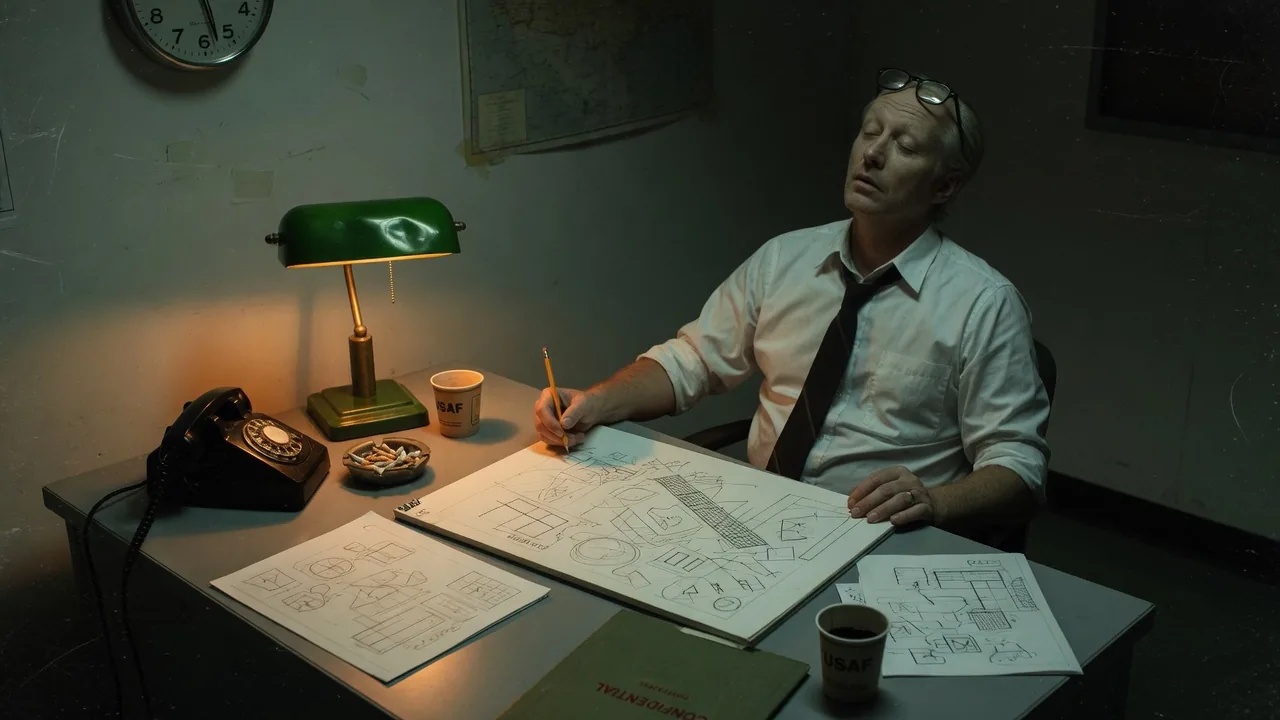
Imagine a windowless room at Fort Meade, Maryland. No maps on the wall. No target briefing with photos and code words. Someone hands a viewer a set of abstract coordinates - numbers that mean nothing to anyone who has not already opened the sealed envelope - and asks them to describe what is there.
Shapes. Textures. A gantry. Underground space. A feeling of cold metal. The session ends with sketches and a verbal dump. Somewhere else in the intelligence community, an analyst decides whether any of it is worth a second look.
That was the working fantasy - and for roughly two decades the working practice - behind what finally got filed under the name Star Gate (often written Stargate): a U.S. government effort to turn remote viewing into a collection tool. It cost on the order of $20 million across agencies and contractors. It left a mountain of declassified paper. And in 1995, after a CIA-commissioned review, it was shut down.[1][2]
How we got here
The story does not start with a Hollywood code name. It starts in the early 1970s at SRI International (then Stanford Research Institute) in Menlo Park, where physicists Harold Puthoff and Russell Targ began testing people who claimed unusual perception - including artist Ingo Swann and former police officer Pat Price.
The Cold War framing was simple and slightly panicked: if the Soviets were pouring money into "psychotronics" and parapsychology, the U.S. could not afford to ignore the file. Early CIA interest and funding fed precursor work often associated with names like SCANATE ("scan by coordinate"). Lab protocols tried to strip out ordinary sensory cues. Viewers described distant sites from abstract cues; judges later matched descriptions against targets and decoys.
Puthoff later summarized the CIA-initiated SRI work in a paper that still circulates as a primary-era insider account - how the lab protocols evolved, who the early viewers were, and why intelligence sponsors kept paying attention.[3] In 1977, Targ and Puthoff also published Mind-Reach, the popular book that carried remote viewing out of classified corridors and into bookstores.
By the late 1970s the work had an operational military face. Army INSCOM stood up a small unit at Fort Meade. Cover names stacked up as budgets and sponsors moved: Gondola Wish, then Grill Flame (from about 1978), later Center Lane, Sun Streak, and eventually consolidation under Star Gate in the early 1990s. Research contractors shifted over time - SRI, later SAIC under figures such as Edwin May. The unit stayed small: often on the order of a dozen to roughly twenty people at peak, not a psychic army.[1]
One of the best-known military viewers was Joseph McMoneagle (often labeled Viewer 001 in later popular accounts). Swann helped develop structured Coordinate Remote Viewing (CRV) training - a staged method that pushed raw sensory impressions first and tried to delay "analytical overlay," the brain's habit of naming things too early and inventing the rest.
Decades later, participants and filmmakers still argue the same fight the files never settled. This overview package walks the public version of the story - SRI, the military unit, and the declassification hangover:
Video: Real Stories package on the military remote-viewing unit and Project Stargate era.[4]
What people claimed
Give the extraordinary version its best day in court and it sounds like this:
Under double-blind or near-blind conditions, certain people can acquire information about distant or shielded targets without ordinary senses. In the lab, hit rates beat chance often enough that serious statisticians argued about it for years. In the field, viewers supposedly described Soviet facilities, helped locate assets, and produced sketches that later looked uncomfortably close to reality.
The set-piece case that never dies is Pat Price and the Soviet complex near Semipalatinsk (often discussed under cover labels like PNUTS / URDF-3) in July 1974. Given coordinates, Price described a multi-story secured complex, heavy-lift gantry crane structure, and underground elements. Proponents say parts of that description tracked with later satellite and intelligence knowledge of the site. Skeptics say the match is selective, the misses get memory-holed, and vague industrial language can be fitted to almost any large facility after the fact.[3]
Another folklore favorite: Ingo Swann's 1973 Jupiter session, in which he described crystalline bands high in the atmosphere - later retold as a prediction of Jupiter's rings before Voyager confirmed a faint ring system in 1979. The charitable reading is a striking atmospheric detail. The careful reading notes that Swann's language is closer to crystal bands in atmosphere than a discrete external ring system, that gas-giant "surface" impressions do not map cleanly onto reality, and that ring-as-proof marketing grew louder after Voyager than in the earliest popular write-ups.
Former viewers and managers have spent decades insisting the 1995 shutdown undervalued operational "hits," that end users wanted miracle specificity the method never promised, and that institutional "giggle factor" made honest use impossible. That is the residual claim from inside the tent: not that every session was magic - that some signal was real and was mismanaged.
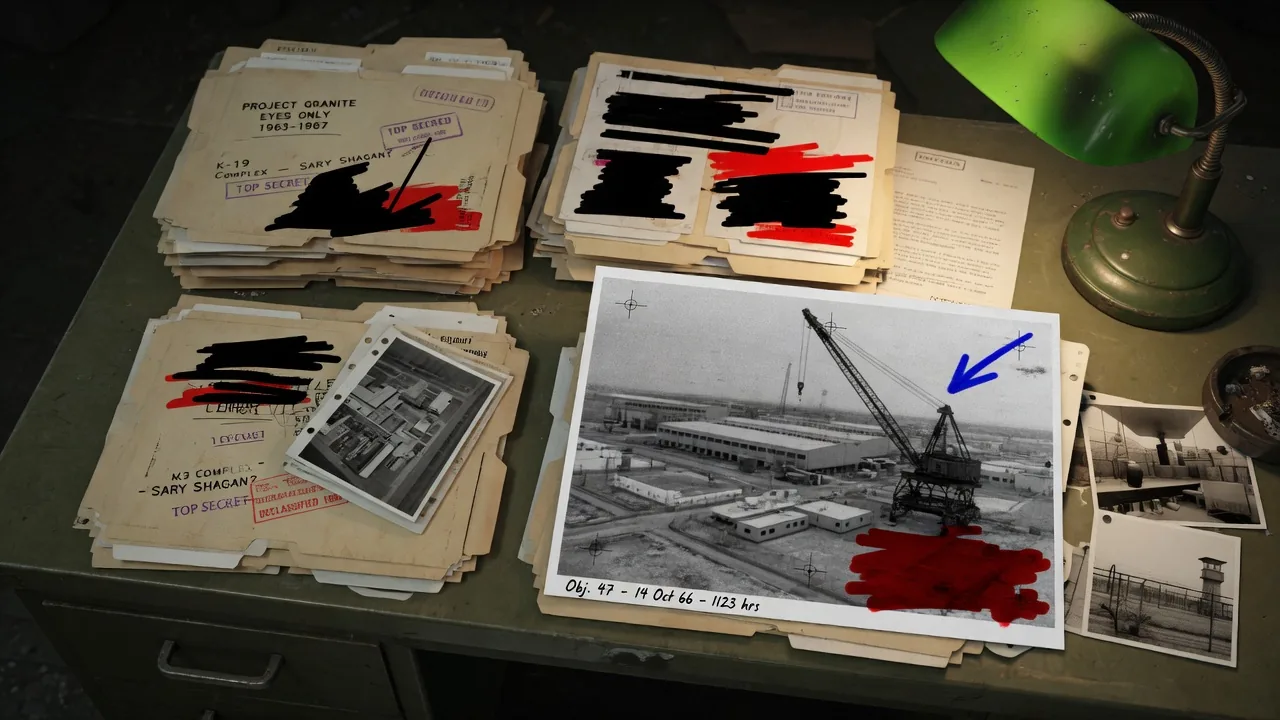
Artist's depiction (not a photograph). The real primary trail is the CIA STARGATE FOIA collection - thousands of pages, not a single smoking-gun folder.
The evidence map
What's relatively solid:
- The programs existed. CIA, DIA, Army INSCOM, and contractors left a paper trail now public in the CIA Electronic Reading Room STARGATE collection and related CREST releases.
- Multiple cover names and a multi-decade span are documented - this was not a single weekend experiment.
- Rough total cost on the order of $20 million appears repeatedly in serious secondary summaries grounded in program materials.
- The 1995 American Institutes for Research (AIR) evaluation is a real primary: Mumford, Rose, and Goslin, with independent reviews by statistician Jessica Utts and skeptic psychologist Ray Hyman.
What's weaker or disputed:
- Any single "famous hit" (Semipalatinsk, Jupiter, lost aircraft stories) as clean proof rather than contested anecdote plus selective matching.
- Whether lab statistical effects equal a paranormal mechanism - or judge effects, target pools, cueing, and analysis choices.
- Operational utility claims that cannot be independently audited session-by-session in public.
- Pop-culture bleed from The Men Who Stare at Goats and later podcasts that flatten Grill Flame, Stargate, and neighboring fringe programs into one joke.
The honest evidence map is not "psychic spies confirmed." It is also not "nothing happened and everyone was stupid." It is: a long, documented government program; lab results that made two smart reviewers disagree about mechanism; and an operational record that the official end-user review called non-actionable.
Competing explanations
1. Genuine anomalous cognition (the residual claim). Utts's side of the AIR debate is the cleanest steelman here. In her 1995 assessment of the lab material, she concluded that using ordinary scientific standards, psychic functioning had been established statistically - small-to-medium effects, far beyond chance, replicated enough that she argued the proof phase was over and process research should begin.[5] Proponents point to structured CRV protocols, long training curves, and participant memoirs (McMoneagle and others) as evidence the signal was managed poorly rather than imaginary.
2. Methodological artifact and subjective validation. Hyman and earlier National Research Council-era criticism emphasize sensory leakage, inadequate blinding, non-independent judging, small effect sizes that do not travel, and the human talent for reading vague language onto known targets after feedback. Under this view, "hits" are what confirmation bias looks like when you have sketches, open-ended adjectives, and motivated analysts.
3. Lab curiosity without field utility (the AIR operational conclusion). The AIR executive summary is blunt in plain English: end users said reports were inconsistent and inaccurate on specifics; information required heavy subjective interpretation; and in no case had remote viewing guided intelligence operations. Lab conditions (feedback, photo pools, ranking tasks) do not map cleanly onto real collection problems.[6]
4. Cold War insurance policy. Even weak anomalous-cognition odds can look worth a small budget if you fear the other side has a breakthrough. Twenty million dollars over decades is enormous for a garage hobby and trivial next to major weapons programs. Termination after 1995 fits post-Cold War triage as much as pure epistemology.
Video: long-form interview with Joseph McMoneagle - primary participant voice, not a neutral audit.[7]
What is known vs. still open
Known with reasonable confidence
- U.S. intelligence and military organizations funded remote-viewing research and operations from the 1970s into 1995 under successive cover names.
- Key research nodes included SRI (Puthoff/Targ era) and later SAIC; operational work centered at Fort Meade under Army/DIA structures.
- CIA commissioned AIR's 1995 evaluation; the program was terminated and later extensively declassified.
- AIR found statistically interesting lab results and concluded operational remote viewing did not produce actionable intelligence.
Still open / unresolved
- What, if anything, caused above-chance lab scoring - psi, subtle method flaws, judge effects, or some mix.
- How many operational taskings would still look impressive under modern, pre-registered scoring with no post-hoc fitting.
- How much of the public legend is session transcript versus memoir and documentary condensation.
- Whether any still-classified appendices or end-user files would change the utility argument (publicly, the AIR line is what we have).
Why it still matters
Stargate is one of the purest case studies in human hacking as statecraft: not a chip in the skull, not a social-media funnel - a bet that consciousness itself might be a sensor. It sits next to MKUltra in the public imagination and should not be collapsed into it. One program dosed and broke people. This one sat people in rooms and asked them to describe the other side of the planet.
It also teaches a research discipline that viral "psychic spy" clips skip: separate laboratory effect size from operational value. You can argue about the first without pretending the second was a settled win. The AIR report is useful precisely because Utts and Hyman did not agree on mechanism - and still converged on "do not keep this as an intelligence product."
Closing
So did the United States run psychic spies? It ran a remote-viewing program, with real budgets, real cover names, real viewers, and real declassified files. Did those sessions unlock the Soviet Union like a crystal ball? The official 1995 answer was no - not in the way intelligence officers need.
What remains is the uncomfortable middle: statistics that refused to be boring, anecdotes that refuse to die, and a paper trail large enough that nobody honest gets to call the whole thing a cartoon. Fort Meade's quiet rooms are empty now. The coordinates are public. The argument is not.
Sources
- CIA FOIA Electronic Reading Room. "STARGATE" collection. https://www.cia.gov/readingroom/collection/stargate
- Federation of American Scientists / IRP. "Stargate" program overview and document pointers. irp.fas.org
- Puthoff, Harold E. "CIA-Initiated Remote Viewing at Stanford Research Institute." newdualism.org
- Real Stories. "Inside The Military's Secret Psychic Unit." YouTube
- Utts, Jessica. "An Assessment of the Evidence for Psychic Functioning." American Institutes for Research evaluation component, 1995. PDF. https://www.ics.uci.edu/~jutts/air.pdf
- Mumford, Michael D.; Rose, Andrew M.; Goslin, David A. An Evaluation of Remote Viewing: Research and Applications. American Institutes for Research, 29 Sept. 1995. National Security Archive PDF. https://nsarchive2.gwu.edu/…/doc_57.pdf
- Shawn Ryan Show. Interview with Joseph McMoneagle. https://www.youtube.com/watch?v=XRTon6qgVws
- Puthoff, Harold; Targ, Russell. Mind-Reach: Scientists Look at Psychic Abilities. 1977. (Contemporary primary-era popular account of early SRI work.)
- The Black Vault. Stargate collection mirror and remote-viewing document archive. theblackvault.com
Further rabbit holes
← Back to 🧠 human_hacking
Method: read the AIR executive summary and Utts PDF before any viewer memoir. Lab stats and ops utility are different claims.
Nearby: Grill Flame / Center Lane / Sun Streak cover-name trail in the CIA STARGATE collection; Gateway Process (related INSCOM consciousness assessment, not the same program).