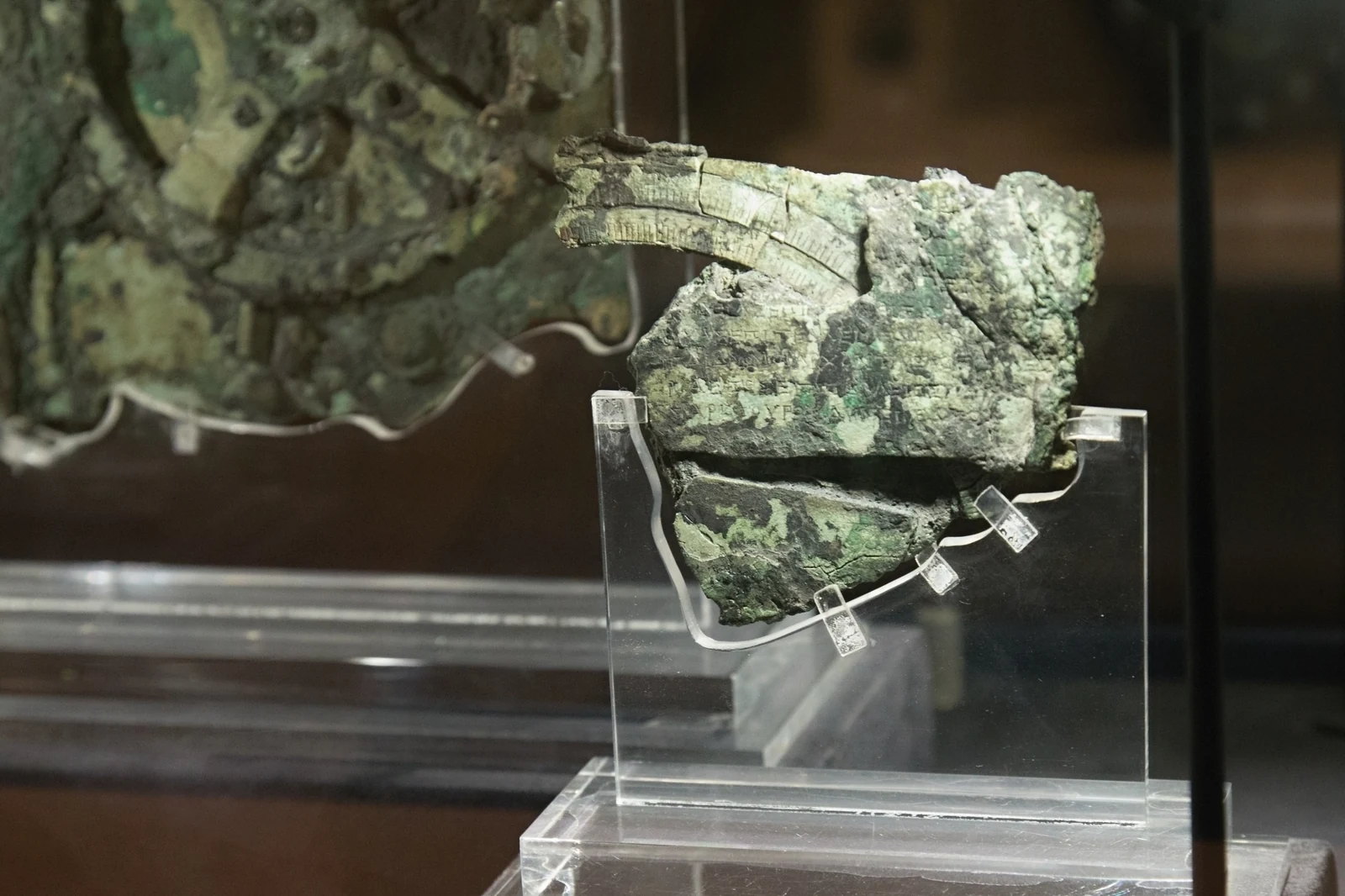
In the spring of 1900, sponge divers from the island of Symi stopped near a small Greek island called Antikythera - between the Peloponnese and Crete - to ride out a storm. When the weather cleared, they went down looking for sponges. What they found instead was a Roman-era shipwreck full of statues, pottery, and luxury cargo that had been heading toward Rome when the sea took the ship, probably around the middle of the first century BC.[1][2]
One diver came up talking about a heap of naked bodies on the bottom. They were marble statues, not corpses - but the shock was real. The Greek government hired the divers to excavate. Through late 1900 and into 1901, they hauled treasures up from about 45 to 60 meters down.
Among the haul was something nobody had a category for: a fused, corroded mass of bronze about the size of a large book, split into fragments, looking more like mineral than machine.
That lump became the Antikythera mechanism - and it quietly wrecked the story of how primitive "ancient technology" was supposed to be.
What the divers actually found
The ship was a wrecked freighter of Greek luxury goods - statues, glass, coins, jewelry - almost certainly bound for wealthy Roman buyers. The mechanism was not the star of the show at first. Marble and bronze sculpture got the headlines. The weird crusted object went to Athens with the rest of the salvage and sat among museum finds while scholars tried to figure out what they were looking at.
Close study started in the early twentieth century. By mid-century, researchers - most famously Derek de Solla Price - had shown that the object was not jewelry or a simple clock face. It was a geared calculating machine. Turning a hand crank would drive a stack of meshing bronze gears that moved pointers on dials. Those dials tracked the sky.[1]
That is the core fact, and it still lands hard: more than two thousand years ago, someone built a portable bronze computer for astronomy.
What the machine did
Modern X-ray and CT scanning - especially work from the Antikythera Mechanism Research Project and later teams including Tony Freeth and colleagues - have mapped the insides without smashing what is left. The picture that emerges is not a toy. It is a packed instrument.[3]
In plain English, when you turned the input, the mechanism could:
- Show where the Sun and Moon sat against the zodiac on a chosen date
- Model the Moon's irregular speed (faster near Earth, slower farther out) - a subtle Greek astronomical idea, done in metal
- Predict eclipses years or decades ahead using long cycles like the Saros
- Track calendar cycles, including the Metonic cycle that lines up lunar months with solar years
- Mark the timing of major Greek athletic festivals, including the Olympic Games
- Likely include planetary displays as well - reconstructions still argue over the exact lost gearing, but the ambition was a model of the known cosmos
Researchers estimate the original device had on the order of 30 to 37 bronze gears meshing together. Many survive only as fragments. Inscriptions on the plates amount to a user manual in ancient Greek - labels for dials, cycles, and instructions that help decode the layout.[1]
Put simply: you set a date, turned the crank, and the machine told you what the heavens would do. Not with electricity. With teeth cut about a millimeter long and gear trains that would not look out of place in a fine watch - except this watch is from the Hellenistic world.
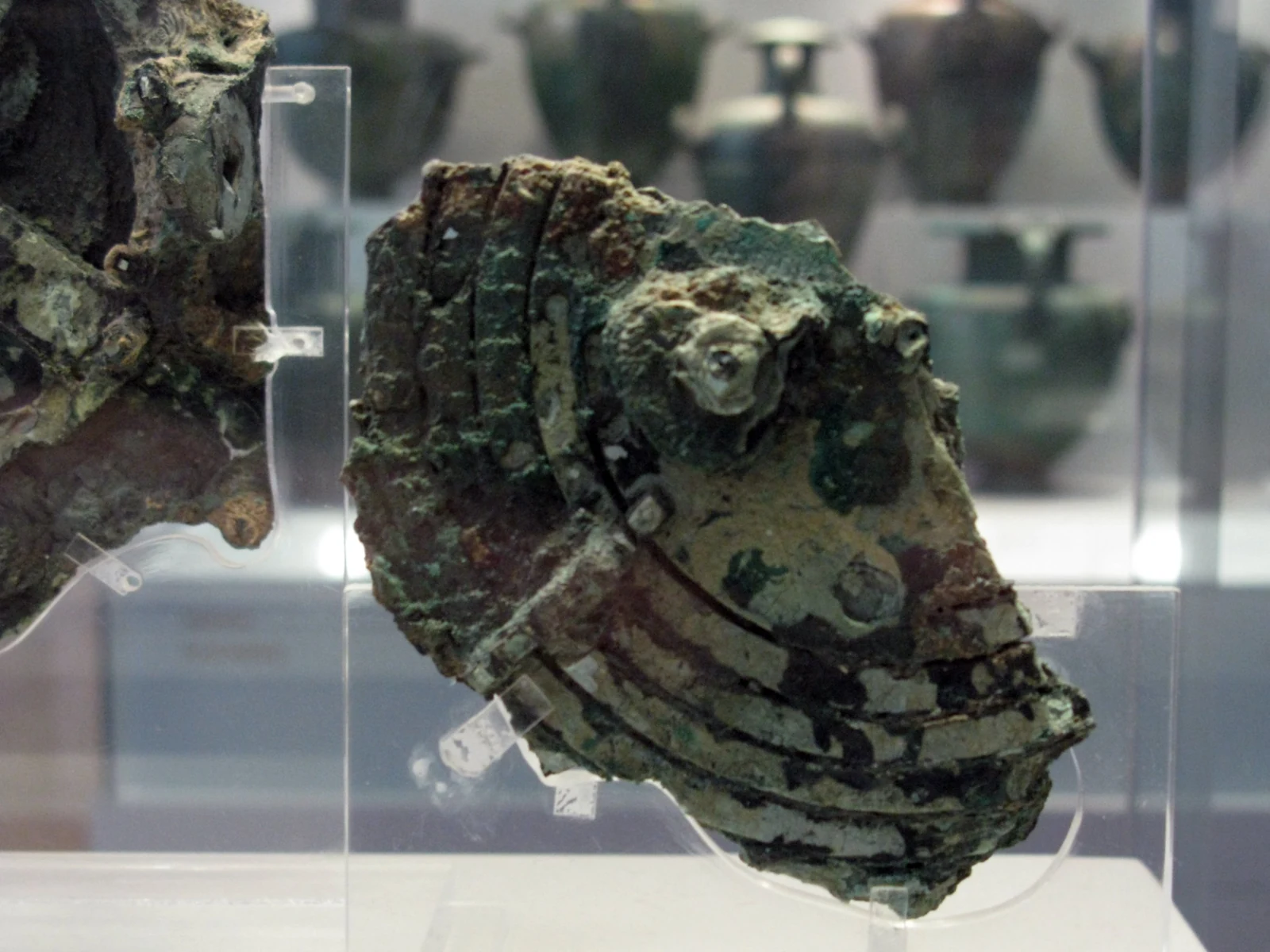
Corroded bronze fragments of the mechanism. Under X-ray, the green crust becomes a three-dimensional gear train.
When was it built, and who built it?
The ship sank around the mid-first century BC, so the machine has to be older than that. Scholars place construction somewhere in the late second to early first century BC - with some arguments pushing toward roughly 150-100 BC, and others favoring dates as early as about 205 BC based on eclipse cycles encoded in the design.[4]
No nameplate says "made by Archimedes." Ancient writers do talk about similar devices. Cicero describes a bronze sphere built by Archimedes that showed the motions of the Sun, Moon, and planets - and mentions other astronomical engines he may have seen associated with Rhodes. The Antikythera machine is the physical proof that those stories were not pure fantasy. It sits in a world of Hellenistic science - Rhodes, Alexandria, Syracuse - where geometry, astronomy, and skilled metalwork could meet in one box.[5]
We still do not know the shop that cut these gears, or whether this was a one-off masterpiece or one survivor from a lost class of instruments. That gap is part of the vertigo. If Greeks could do this once, what else went to scrap, rust, or the bottom of the sea?
Why it rewrites the timeline
Before Antikythera was understood, the standard picture of Greek tech leaned hard on temples, ships, and simple gears for mills. Complex geared clocks and calculators were thought of as much later achievements - medieval Europe, the Islamic world's astronomical instruments, Renaissance clockwork.
This object punches a hole in that story. It shows epicyclic gearing - gears riding on other gears - and fine tooth work that looks closer to precision engineering than to "primitive antiquity." Nothing else this sophisticated is known to survive from the ancient Mediterranean for roughly the next thousand years.[2]
That does not mean aliens built it. It means our default history of technology was incomplete. Knowledge can exist, get used by a small class of experts, then vanish when the social chain breaks - no mass production, no paper trail that survives, no second copy in a museum case. One wrecked freighter is enough to almost erase a whole category of machine.
How we figured it out
For decades the mechanism was studied with eyes, microscopes, and early X-rays. Price's mid-century work put "gears from the Greeks" into serious academic conversation. Then high-resolution surface imaging and three-dimensional X-ray tomography in the 2000s and 2010s unlocked inscriptions and gear teeth hidden inside the corrosion. Papers in journals like Nature mapped eclipse predictions, Olympic cycles, and more detailed reconstructions of the front and back dials. In 2021, Freeth and colleagues published a further model of the cosmos display - still arguing, still refining, but no longer guessing in the dark.[3]
Today the fragments live at the National Archaeological Museum in Athens. Working replicas sit in labs and exhibitions worldwide so people can turn a handle and watch the ancient sky move.
For a deep walk through the research - discovery, X-rays, and what the dials actually compute - mathematician and Antikythera researcher Dr. Tony Freeth gave this lecture at Stanford:
Video: Stanford - Tony Freeth on the Antikythera mechanism (lecture).[7]
What is settled and what is still fuzzy
Settled enough to teach: it is a real ancient Greek bronze gear computer from roughly the late Hellenistic period; it was recovered from the Antikythera wreck in 1901; it calculates astronomical and calendrical cycles far beyond "simple decoration."
Still argued: exact build year; exact planetary gearing that is now missing; whether this was unique or one of many; which city or school produced it; how widespread such machines were before the craft died out.
The mystery is not "is it a computer?" The mystery is how much of that engineering world was lost - melted for scrap, left unrecorded, or still sitting on the seafloor. Divers thought they had found statues that looked like corpses. They also found a machine that looked like junk. The statues were art. The junk was the sky, folded into metal.
Sources
- Grokipedia. "Antikythera mechanism." grokipedia.com/page/Antikythera_mechanism
- History.com. "How the Secrets of an Ancient Greek 'Computer' Were Revealed." history.com
- Freeth, T., et al. "A Model of the Cosmos in the ancient Greek Antikythera Mechanism." Scientific Reports (Nature), 2021. nature.com
- Voulgaris, A., et al. / overview: "The Antikythera Mechanism." Communications of the ACM, 2020. cacm.acm.org
- World History Encyclopedia. "Antikythera Mechanism." worldhistory.org
- National Archaeological Museum, Athens - permanent display of the Antikythera finds (museum home for the fragments). namuseum.gr
- Stanford / Dr. Tony Freeth. "The Antikythera Mechanism: A Shocking Discovery from Ancient Greece." Lecture video. youtube.com/watch?v=xWVA6TeUKYU
Further rabbit holes
← Back to ⚗️ ancient_tech
Related: Cicero on Archimedes' sphere, Hellenistic Rhodes as a science hub, and why one wreck can erase a whole technology class.